Physical Address
304 North Cardinal St.
Dorchester Center, MA 02124
Physical Address
304 North Cardinal St.
Dorchester Center, MA 02124

My first travel backpack was chosen the way I choose most things when I’m excited: quickly, and by looks. It was a 65-litre beast in a confident shade of green, and I filled it to the zipper because it was there. By day three I had learned that a pack will happily swallow every “just in case” item you own, and that a hip belt resting on your ribs is just a very expensive shoulder strap.
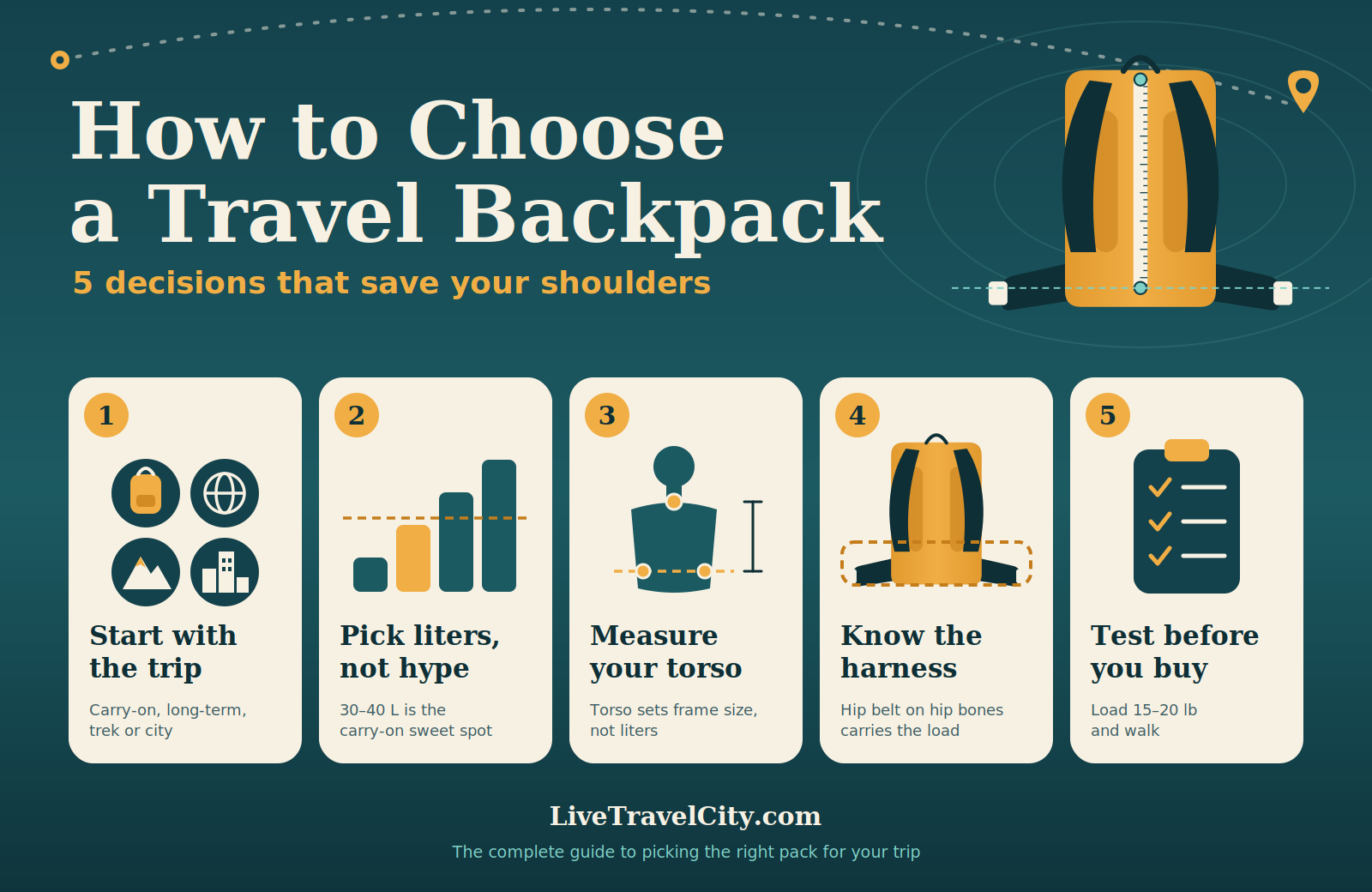
So how do you choose a travel backpack that won’t teach you the same lesson? Work through five decisions, in this order: how you’ll fly, how many liters you need, which frame size fits your torso, how the harness and opening style suit your trip, and whether the pack still feels good once it’s loaded.
The quick answer: For most trips, pick a 30–40 liter pack that fits airline carry-on limits. Measure your torso length (not your height) to find your size. Look for a padded hip belt that sits on your hip bones, a suitcase-style opening, and a harness that tucks away for flights. Then load it with 15–20 pounds and walk around before you commit.
The rest of this guide explains each step, including the places where popular advice goes wrong.
Start with the pack’s job, because “travel backpack” covers at least four very different animals.
Write down which one you are. Everything else in this guide gets easier once that’s settled, and most backpack regret comes from buying for the trip you imagine rather than the one you take.
Capacity is measured in liters [the volume of the bag’s interior, like a water bottle but for socks], and most of us overbuy.
Many guides call 50–70 liters the “sweet spot” for trips of a few weeks. For travel, that’s too much. A pack that size won’t qualify as carry-on on most airlines, and a bag always fills to its capacity, whether or not the contents earn their place. Bigger isn’t better here; it’s just heavier.
One more wrinkle: liters are a loose measure. Brands calculate volume differently, so one company’s 40L can be another’s 36L. Treat the number as a rough guide and check the actual dimensions.
This is where liters stop mattering. Airlines don’t measure in liters. They measure inches or centimeters, and sometimes weight.
Here is roughly what to expect, though every airline differs and rules change:
The takeaway: on a cheap European fare, a 40-liter pack is not “free.” It’s a paid cabin bag. If you want to fly on the free allowance alone, you’re shopping for an 18–20 liter pack.
Three habits save you at the gate:
A 40-liter pack usually squeaks into carry-on limits, but “usually” isn’t a guarantee. If you fly budget airlines often, buy a pack built to a specific airline size, not just a liter count.
Because a backpack hangs from your torso, not your legs. That’s why a tall person with a short torso can wear a medium, and why sizing charts ask for a measurement most people have never taken.
Here is the correction to a common mistake: torso length determines your frame size (small, medium, large), not your bag’s capacity in liters. A small-framed pack and a large-framed pack can both be 40 liters. Matching a short torso to a “smaller” 30–50L pack, as some guides suggest, makes no sense. You pick the liters for your trip, then the frame size for your body.
To measure your torso length, you’ll need a flexible tape measure and a friend:
Retailers’ charts vary a little, but a common split runs small up to about 17½ inches, medium from roughly 18 to 19½, and large from 20 inches up, with extra-small sizes below about 16. If you land between sizes, try both. Some packs also have adjustable torso lengths, which is handy if you’re between sizes or share a bag.
Your hip size matters too. Many packs sell hip belts in separate sizes, and some have swappable ones. If the belt can’t cinch snugly around your hips, the rest of the fit won’t matter.
Should you buy a women’s-specific pack? Often, yes, though it’s worth trying both. Women’s and “short torso” versions usually have a shorter frame, narrower and more curved shoulder straps, and a hip belt shaped for wider hips. Plenty of men and women find that a pack labeled for the other group fits better, so let the measuring tape and a loaded walk around the shop decide, not the label.
Picture the weight of a loaded pack as a toddler you’re carrying for six hours. You’d want it sitting on your hips, not hanging off your shoulders. That’s what a hip belt is for.
Here’s the honest caveat that many guides skip: small travel packs often have thin hip belts. Under about 35 liters, the belt may be little more than a stabilizer. That’s fine for lighter loads, but if you plan to carry 25 pounds all day, look for a bigger, padded, weight-bearing belt.
For most travelers, panel-loading wins. A panel-loading pack [one that unzips around three sides, like a suitcase] lets you see and reach everything without unpacking from the top down. If you’re changing hostels every two nights, that matters more than almost any other feature.
Top-loading packs [one big opening at the top, closed with a drawcord and a lid] are better at keeping rain out and at carrying weight well, which is why they’re common on trek-focused bags. The downside is digging for the sock at the bottom.
A few related choices:
Worth it:
Probably overkill:
Remember that water-resistant isn’t the same as waterproof. A water-resistant fabric sheds light rain, but heavy downpours soak through seams and zippers. Use a pack liner or a dry bag for anything that mustn’t get wet.
Also pay attention to the empty weight of the pack. Heavy, over-built bags eat into your airline weight limit before you’ve packed a single sock.
Never judge a pack empty. An empty backpack tells you nothing about how it carries.
Most good travel backpacks land somewhere between $100 and $300, depending on materials, brand, and features. Prices vary and sales are common, so treat that as a rough range, not a rule.
Spend more if you travel often, have back problems or unusual fit needs, or do serious outdoor activity alongside regular travel. A well-fitted pack with a good warranty can last for years.
Save money if this is your first big trip, you’re not sure what you prefer, or you travel only occasionally. A mid-range pack from a reputable brand will usually outlast the trips you take with it.
Plenty of travelers combine a city trip with a few days of walking, and Nepal is a good example. A standard travel pack handles the city days in Kathmandu and Pokhara just fine. The trail is a different story.
On many Nepal treks, porters carry your main bag, and agencies tend to cap porter loads well below what a full-size backpack holds. Domestic flights to mountain airstrips such as Lukla commonly have strict weight limits too, often around 15 kg in total, so confirm the current figure with your airline or agency. The usual solution is a small daypack (20–30 liters) for water, layers, and valuables, plus a duffel for the rest. A simple setup is to leave your travel pack with spare clothes at your Kathmandu hotel and take only what you need.
If you’re doing the trek solo and carrying everything yourself, you’ll want a proper trekking pack with a real suspension system, not a travel pack with a token hip belt.
Put it all together and the decision gets a lot smaller. If you’re flying carry-on only for one to three weeks, you want a 30–40 liter panel-loading pack that fits your airline’s dimensions, with a padded hip belt. If you’re away longer or crossing climates, go to 40–55 liters, add a stowable harness, and find the discipline to leave half your “just in case” pile at home. For city breaks and short hops, stay under 30 liters and keep it light. And if trekking is on the itinerary, buy a trek-ready pack with a real suspension system and bring a daypack for the city days.
Measure your torso, check the airline’s numbers, load the pack, and walk around. None of it takes long. A few minutes of fuss now beats days of sore shoulders later, and a good pack, once you find it, is one of the few things in travel that gets better the more you use it.