There’s a particular kind of dread that sets in the night before a trip. You’re staring at an open suitcase, wondering if you’ve packed too much, too little, or somehow managed both at once. Half your bed is covered in clothes you’ll never wear. The other half has that one thing you’ll absolutely need on day three but can’t find. Sound familiar?
After years of arriving at airports with three types of adapters but no toothbrush, I’ve finally cracked the code on building a packing list that actually works – one that fits whatever trip you’re taking without turning your suitcase into a game of Tetris you’ll definitely lose.
This is that list. Adapt it, steal it, print it out and tape it to your wardrobe. Just don’t leave home without it.
Before You Even Open the Suitcase
The single biggest packing mistake most people make? Starting with what to pack instead of how much space they have. Your packing list should always follow your luggage choice, not the other way around.
Carry-on only: Typically 45 linear inches (22 x 14 x 9 inches). Forces discipline. Ideal for trips up to 10 days if you pack smart.
Checked bag: More room, but also more temptation. A 25-inch checked bag is the sweet spot for 2+ weeks without becoming the person who has to sit on their suitcase to zip it.
Personal item: A backpack or tote that fits under the seat in front of you. This is your in-flight survival kit and your biggest secret weapon.
Once you’ve settled on your luggage, the list becomes much easier to write — because you’re packing to a hard limit, not an imaginary one.
The Ultimate Travel Checklist
🛂 Travel Documents
These are the non-negotiables. Lose your sunscreen, fine. Lose these, and your trip is over before it begins.
- Passport (check expiry — many countries require 6 months validity beyond your travel dates)
- Visa printouts or e-visa confirmation (if required)
- Flight tickets / booking confirmations
- Hotel reservations
- Travel insurance documents
- Driver’s license or secondary photo ID
- Emergency contact list (written down, not just on your phone)
- Vaccination records (increasingly required for international travel)
- Copies of all the above — stored separately from the originals
Pro tip: Photograph every document and email them to yourself. If your bag disappears, your phone probably won’t, and that email could save your entire trip.
💳 Money & Cards
- Primary debit/credit card
- A backup card (different bank if possible)
- Small amount of local currency for arrival
- Coin purse or small wallet for cash
- Money belt or hidden travel wallet for high-risk destinations
👕 Clothing
This is where most travelers go catastrophically wrong. The rule I now swear by: lay out everything you think you need, then put half of it back.
The core formula for any trip:
- 1 outfit per 2–3 days (most hotels have laundry; many have coin-operated machines)
- A base layer that works with everything
- One “nice” outfit for dinners or events
- One warm layer, regardless of destination (planes are cold; so are over-air-conditioned restaurants)
Specific items:
- T-shirts / tops (3–5 depending on trip length)
- Lightweight long-sleeve layer
- Trousers or jeans (1–2 pairs — jeans are heavy, so think carefully)
- Shorts (1–2 pairs, destination-dependent)
- Versatile dress or smart casual outfit (can double as both beach cover-up and dinner wear)
- Underwear (1 per day, plus one extra — merino wool dries overnight and barely takes up space)
- Socks (same rule as underwear; wool socks resist odour longer)
- Comfortable walking shoes (worn on the plane, not packed)
- Sandals or flip-flops
- Dress shoes or boots only if you have a specific occasion requiring them
- Packable rain jacket or windbreaker (this earns its weight every time)
- Swimsuit (takes up almost no space; devastating to forget)
- Pyjamas or sleep clothes (light and packable)
- Scarf or sarong (does triple duty: sun cover, beach towel, impromptu blanket on long flights)
Packing hack: Roll, don’t fold. You’ll fit significantly more, and most items arrive with fewer creases than you’d expect. Packing cubes are worth every penny — they compress clothing and keep your bag from becoming a fabric archaeology dig.
🧴 Toiletries
The toiletries bag is where most of us overpack. You will not use that third moisturiser. You will not need three types of dry shampoo.
The essentials:
- Toothbrush + toothpaste (travel size)
- Floss
- Deodorant
- Shampoo + conditioner (small bottles, or solid bars to avoid liquid limits)
- Body wash or soap
- Face wash + moisturiser
- Sunscreen (do not skip this, and do not assume you can easily find your SPF preference abroad)
- Lip balm with SPF
- Razor + shaving cream or a travel epilator
- Feminine hygiene products if needed
- Nail clippers + file
- Tweezers
- Cotton pads / cotton buds
- Small mirror
- Perfume or cologne (roll-on format to avoid breakage)
- Hairbrush or comb
- Travel hairdryer (optional — most hotels provide one; check before packing)
- Hair ties and bobby pins
Liquid rule for carry-on: Each liquid must be 100ml or under, all fitting into one clear 1-litre bag. Solid toiletries (bars, sticks, balms) sidestep this entirely and are worth switching to.
💊 Health & Medications
This is the category you think about least before a trip and most during one, usually from the bathroom floor of a foreign hotel at 2am.
- Prescription medications (enough for the full trip plus a few extra days)
- Pain relief (paracetamol, ibuprofen)
- Antihistamines
- Anti-diarrhoea tablets
- Rehydration sachets
- Motion sickness medication if needed
- Antacids
- Cold and flu capsules
- Throat lozenges
- Antiseptic cream
- Plasters / bandages
- Blister prevention pads (essential for walking-heavy trips)
- Eye drops
- Hand sanitiser
- Any specialist medication for your destination (anti-malarials, altitude sickness pills, etc.)
One thing I never travel without: a small pill organiser. It keeps daily meds separated and prevents the horror of realising you’ve been taking double doses because two loose bottles look identical in a dark bag.
💻 Electronics & Tech
The fastest-growing category on any packing list, and also the heaviest if you’re not careful.
Core items:
- Smartphone + charger
- Power bank (check airline limits — typically 100Wh or 27,000mAh maximum in carry-on)
- Universal travel adapter (one good one beats four cheap ones)
- Laptop or tablet (if needed) + charger
- Earphones or headphones
- E-reader (a game-changer for long trips)
- Camera + memory cards + charging cable
- USB cable(s)
- Cable organiser pouch — a small investment that prevents catastrophic tangling
Optional but often justified:
- Portable Wi-Fi hotspot (invaluable in countries with unreliable public Wi-Fi)
- Laptop stand + portable keyboard for longer work trips
- Noise-cancelling headphones (the single best purchase for frequent flyers)
- Smart watch
🎒 Carry-On Essentials
What goes in your personal item is its own art form. This is your survival kit for the journey itself — and for the first 24 hours if your checked bag decides to take a detour.
- Travel pillow (inflatable ones take up no space)
- Eye mask and ear plugs
- Reusable water bottle (fill after security)
- Healthy snacks for the flight
- Entertainment: book, downloaded shows, playlist
- Change of clothes (specifically useful if you’re checking a bag)
- Any liquids exceeding the 100ml limit that you can’t live without (check airport rules)
- Pen (for immigration forms, still depressingly paper-based in many countries)
- Antibacterial wipes (for tray tables — I’m one of those people)
- Compression socks for long-haul flights (genuinely useful, not just hypochondriac theatre)
- Mini first aid kit
- Copies of travel documents
🧳 Luggage Accessories
The things that make everything else work better:
- Packing cubes (seriously, just get them)
- Luggage scale (weigh at home, not at the check-in desk while 40 people stare at you)
- Luggage lock (TSA-approved if travelling to or through the US)
- Luggage tag with your contact details
- Bright luggage strap or identifier (every black suitcase looks the same on the carousel)
- Dry bag or waterproof pouch for beach, boat or rainy destinations
- Collapsible tote bag for day trips and shopping
Destination-Specific Add-Ons
A packing list for a beach week and a packing list for a trekking expedition share maybe 40% of their DNA. Here’s what to layer on top:
Beach / Tropical Destinations
- Multiple swimsuits (they take days to fully dry)
- Reef-safe sunscreen
- Rashguard or sun shirt
- Waterproof sandals
- Snorkel set (if you’re particular about fit — rentals exist but aren’t always clean)
- Waterproof phone case
- After-sun lotion
- Insect repellent
Cold Weather / Winter Trips
- Thermal base layers
- Insulated jacket (packable down is best)
- Waterproof outer layer
- Wool or fleece mid-layer
- Warm hat, gloves, scarf
- Thick socks and waterproof boots
- Hand warmers
- Lip balm (cold weather is brutal on lips)
Hiking / Adventure Trips
- Moisture-wicking, quick-dry clothing
- Sturdy hiking boots (broken in before the trip — never debut new boots on a mountain)
- Trekking poles if needed
- Headlamp + spare batteries
- Multi-tool or pocket knife
- High-SPF sun protection
- Electrolyte sachets
- Emergency whistle and basic first aid kit
- Waterproof backpack or pack liner
- Detailed maps or offline navigation app
Business Travel
- Wrinkle-resistant or packable suit
- Dress shirts (pack in dry-cleaning bags to reduce creasing)
- Formal shoes in a shoe bag
- Business cards
- Portable phone charger for long meeting days
- Travel-sized ironing kit or wrinkle-release spray
✈ Free travel checklist
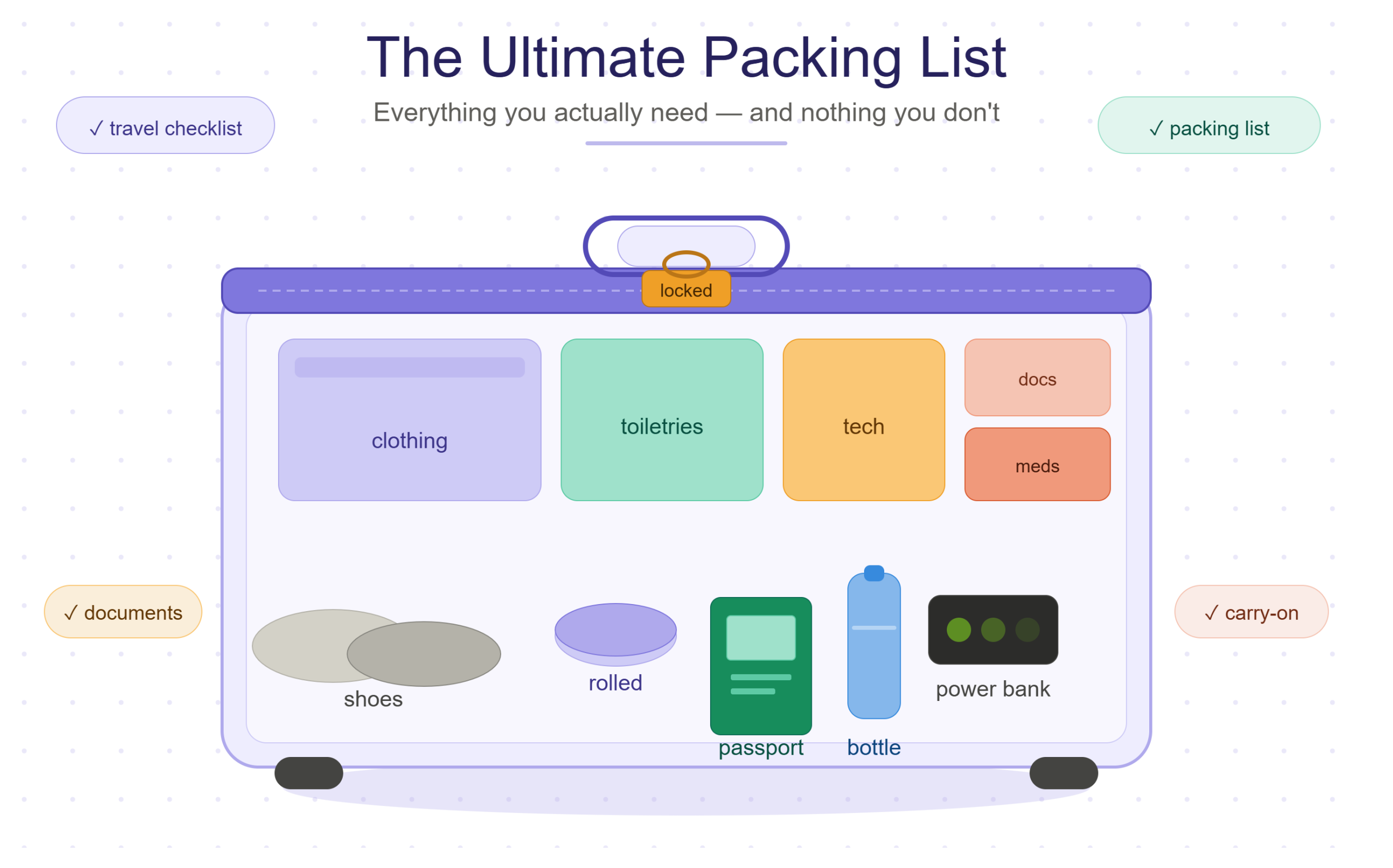
The Ultimate
Packing List
Everything you actually need for your next trip — organised, checkable, and built so you never stand in a hotel room wondering what you forgot.
✓
Passport & visa printouts
✓
Travel insurance documents
✓
Driver’s licence / secondary ID
✓
Copies of everything above
✓
Primary debit/credit card
✓
Backup card, different bank
✓
Compact wallet or coin purse
✓
Hidden travel wallet (if needed)
✓
Tops, 3–5 depending on length
✓
Trousers, jeans & shorts
✓
Underwear & socks, 1 per day
✓
Toothbrush, paste & floss
✓
Shampoo, conditioner, body wash
✓
Sunscreen & lip balm SPF
✓
Clear 1-litre liquids bag
✓
Prescription medications
✓
Pain relief & antihistamines
✓
Anti-diarrhoea & antacids
✓
Plasters & antiseptic cream
✓
Universal travel adapter
Pro tip
Do a test pack 48 hours before departure, not the night before. That gap gives you time to notice what’s missing — and actually do something about it.
The Things People Always Forget
Based on absolutely unscientific but highly personal experience, these are the items most likely to cause a convenience-store emergency at your destination:
- A physical pen (airports and immigration forms are stuck in the past)
- Sunscreen — or enough of it
- A small day bag or day pack for sightseeing
- Plug adapter
- Laundry bag (for dirty clothes — separating them from clean ones matters more on day six)
- Comfortable shoes for travel days that aren’t trainers (look presentable, don’t suffer)
- Enough of any prescription medication — always pack more than you think you need
- Extra passport photos (some visas on arrival still require them)
- A note of your blood type and medical conditions, in the local language for higher-risk destinations
- Your brain. Specifically, the reminder to actually cross everything off the list before zipping up.
How to Build Your Personalised Packing List
A universal packing list is a starting point, not a destination. Here’s how to make this one yours:
1. Start with your trip type. Beach trip, business trip, backpacking, city break — each has its own core requirements. Build from the relevant section above.
2. Know your weather. Check the 10-day forecast a week before you leave, not when you’re packing. Pack for the actual weather, not the weather you hope for.
3. Research your destination’s norms. Conservative dress codes at religious sites, dress codes for restaurants, cultural expectations around clothing — a quick search saves embarrassment.
4. Work backwards from your luggage. Decide what bag you’re taking first. Everything else has to fit.
5. Do a test pack 48 hours before. Not the night before. 48 hours gives you time to realise you forgot something and actually do something about it.
6. Weigh your bag. Not to feel bad about it — to avoid the £60 overweight fee at check-in.
What to Leave Behind
Packing light is a skill. Leaving things behind is how you develop it.
Things you almost certainly don’t need:
- More than two pairs of shoes beyond the ones you’re wearing
- “Just in case” outfits for scenarios that won’t happen
- Full-sized toiletries for a one-week trip
- A hairdryer (most accommodations provide one)
- Towels (ditto, unless you’re camping)
- Books (one e-reader outweighs this argument entirely)
- Every charger you own (most modern devices share USB-C; one cable often handles the lot)
The goal isn’t to pack the minimum possible. It’s to pack only what you’ll actually use, so that everything in your bag earns its place.
Printable Packing List Quick Reference
Here’s the condensed version to bookmark or print:
Documents: Passport, visas, bookings, insurance, IDs, emergency contacts, copies of everything
Money: Cards (x2 minimum), local cash, backup payment method
Clothing: Tops (3–5), bottoms (2–3), underwear (1 per day), socks, warm layer, rain jacket, swimsuit, comfortable shoes, sandals, one smart outfit
Toiletries: Toothbrush + paste, deodorant, sunscreen, shampoo, skincare, razor, feminine hygiene, nail clippers
Health: Prescriptions, pain relief, antihistamines, stomach tablets, antiseptic, plasters, hand sanitiser
Tech: Phone + charger, power bank, adapter, laptop if needed, earphones, camera
Carry-on: Travel pillow, eye mask, water bottle, snacks, change of clothes, documents
Extras: Packing cubes, luggage lock, day bag, laundry bag, luggage scale
Packing doesn’t need to be the worst part of any trip — though for most of us, it’s a strong contender. With the right list, the right sequence, and the discipline to leave the fourth pair of shoes at home, you can arrive anywhere feeling like someone who has absolutely got this.
Even if you spent the previous night frantically slathering your hands with sanitiser and wondering whether to pack the hazmat suit. Just in case.