Physical Address
304 North Cardinal St.
Dorchester Center, MA 02124
Physical Address
304 North Cardinal St.
Dorchester Center, MA 02124

My first stealth camp was entirely accidental. I was cycle touring in rural France, dusk was arriving faster than I’d planned, and the nearest campsite was 25 kilometers away. I wheeled my bike behind a hedgerow, unrolled my sleeping mat, and lay there rigid in the dark, half-convinced every rustle in the undergrowth was an angry farmer. By morning, I’d slept surprisingly well, and no one had noticed me at all.
That night taught me something useful: stealth camping is less about skulking in shadows and more about reading your environment, moving quietly, and leaving no evidence you were ever there. Call it wild camping, free camping, rough camping, or boondocking, they all boil down to the same thing: sleeping somewhere of your own choosing, outside the official system of paid campsites and permits. Whether you’re a budget-conscious bikepacker, a van lifer navigating city streets, or just someone who finds the idea of sleeping wherever the road takes you genuinely thrilling, this guide covers everything you need to do it well, legally (where possible), and without the middle-of-the-night knock you’ve been dreading.
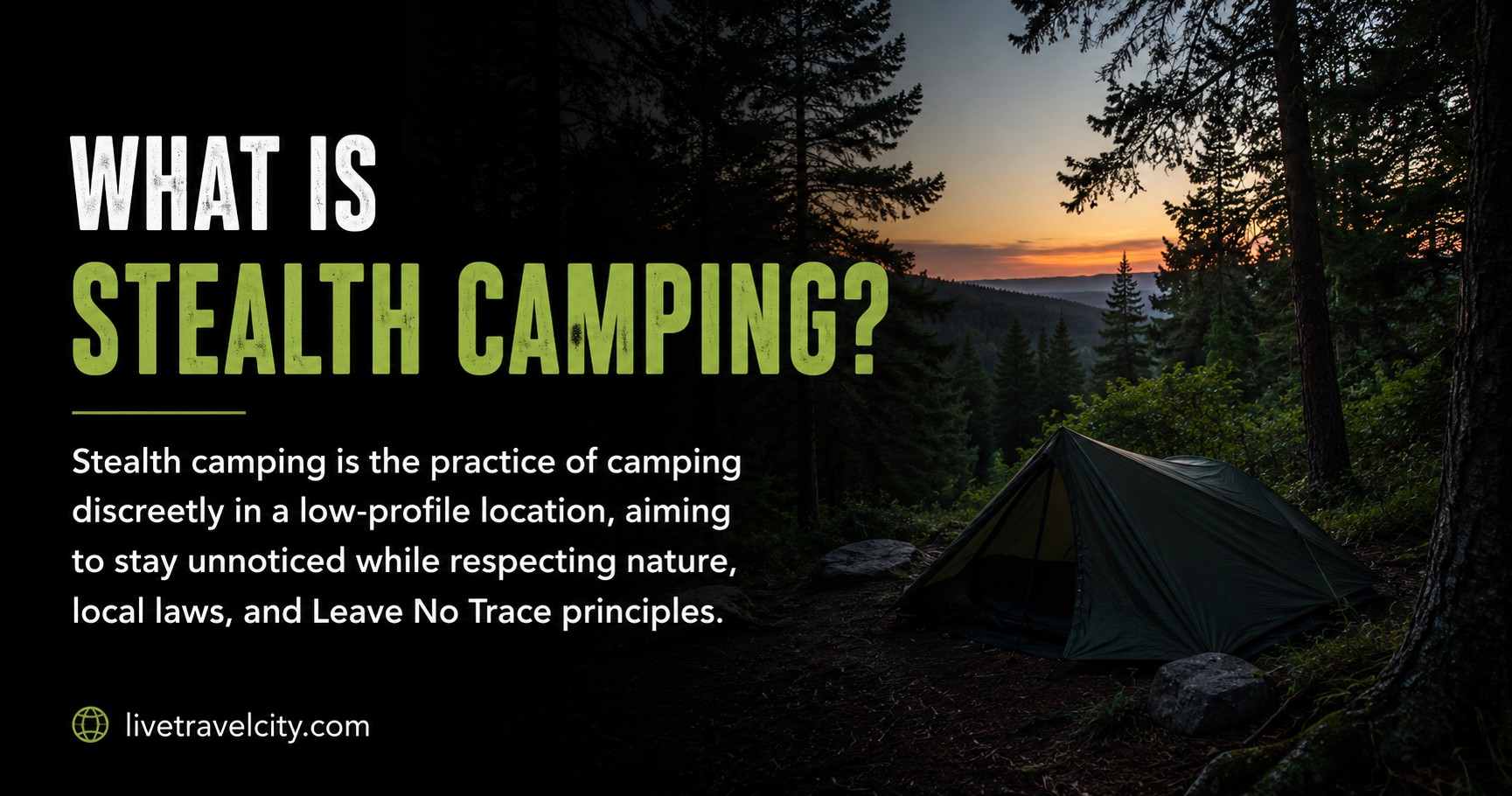
Stealth camping is the practice of setting up camp in a non-designated area without drawing attention to yourself. The “stealth” part isn’t about fear or deception, it’s about minimizing your footprint so you don’t disturb the environment or the people around you, and so they don’t disturb you.
It’s the hiker who slips into a patch of forest just as the light fades, pitches a bivy bag between two fallen logs, and is gone again before anyone passes on the trail below. It’s the van lifer who parks on a quiet side street in Chicago, has blackout curtains on every window, and wakes up to move on before the neighborhood stirs. It’s the cycle tourist who asks the farmer at the edge of the field if they can pitch a tent in the corner for the night and gets a shrug and a yes.
The definition stretches wide. What unites all versions of it is the goal: one night, low impact, invisible.
This is the question that stops most people, and the honest answer is: it depends entirely on where you are and what land you’re on.
In the United States, dispersed overnight camping on Bureau of Land Management (BLM) land and national forests is generally legal and free for up to 14 consecutive days per location, after which you must move at least 25 miles before returning. This is the most straightforward, lowest-risk version of stealth camping, you have federal permission to be there, and the primary concerns shift from enforcement to safety and leave-no-trace ethics.
In urban environments, the picture murkier. Posted parking restriction signs are the fastest indicator of legality, but the absence of a sign doesn’t automatically mean permission, local municipal codes vary enormously. Urban stealth camping in a vehicle is often technically illegal but widely tolerated if you’re inconspicuous, respectful, and move on in the morning.
Internationally, the variation is even wider. Scotland and Sweden permit wild camping on most unenclosed land under their respective right-to-roam laws. England, Italy, and many other European countries have stricter regulations, though practiced responsibly and discreetly, stealth camping is often tolerated even where it’s technically prohibited. The key word is responsibly.
A useful mental check: are you camping here in a way that, if everyone did the same thing, would damage the land or the community? If the answer is no, you’re probably doing it right.
Before the gear lists and location tips, there are a handful of principles that experienced stealth campers live by. Violate them and you’ll either get moved on, ruin the spot for the next person, or both.
Arrive late, leave early. This is the cardinal rule. Showing up after dark means fewer eyes on your setup. Leaving before most people are awake means fewer interactions and fewer complaints. The window between 9 PM and 6 AM is your friend.
One night only. Stealth camping is for passing through, not setting up a base camp. Overstaying turns a tolerated practice into a nuisance and often ruins the spot for everyone who comes after.
Leave no trace — and then some. Pack out everything. Don’t dig trenches, cut vegetation, or leave fire rings. The goal isn’t just to not make things worse; it’s to leave the site as if you were never there.
Don’t broadcast your location. Avoid posting your stealth camp to social media while you’re still there — or at all, if it’s a sensitive spot. The appeal of stealth camping disappears if you map out all the good spots and send them to 50,000 followers.
Trust your instincts. If a spot feels sketchy or unsafe, move on. No perfect night’s sleep is worth a bad situation.
Scouting during daylight is almost always better than arriving blind in the dark. Use Google Earth or an app like Gaia GPS or OnX Offroad (which work offline once downloaded) to identify potential sites before you lose cell coverage. Look for areas with natural cover- dense trees, rock formations, hollows in the terrain- set back from roads and trails.
The standard guidance is to aim for at least 200 feet (about 60 meters) from any road, trail, or water source. That distance provides enough visual cover while keeping you within manageable distance of your route. In more open terrain, you may need to go further. In dense forest, you might be invisible at 50 feet.
Water sources are a double-edged sword. They’re convenient for refilling bottles, but they also attract wildlife and other campers. Camping too close also damages riparian ecosystems. Keep your distance.
Topography matters for comfort. Flat ground is obvious, but completely flat ground collects water. A gentle slope that faces away from the prevailing wind, with a slight natural hollow for concealment, is the sweet spot. A gentle slope lets rainwater drain around you rather than pooling underneath.
For urban van camping, the calculus is different. Look for middle-class neighborhoods with plenty of other street-parked vehicles so you don’t stand out. Hotel parking lots, hospital parking lots, truck stops, and large retail lots like Walmart (where permitted) are popular options. The logic is the same as in the wilderness: blend in with what’s already there.
Traditional camping gear is designed for visibility- bright tents, headlamps that flood a clearing with white light, rustling plastic bags. Stealth gear is the opposite. The goal is a small footprint, muted colors, and quiet operation.
Shelter. A standard bright-orange tent is a beacon. For stealth camping, look for low-profile shelters in earth tones- olive, camo, brown, dark grey. A bivy bag is the gold standard: it sits close to the ground, has a tiny silhouette, and can be tucked behind a fallen log or inside a thicket. If you prefer a tent, look for something that pitches low without freestanding poles that catch the skyline.
Sleeping system. A quality sleeping bag rated to the expected low temperature and a light sleeping mat. Nothing flashy required here- warmth and packability matter more than branding.
Lighting. This is where many beginners go wrong. A headlamp blazing at full brightness through a tent wall at 10 PM is the single most reliable way to announce yourself to anyone within a quarter-mile. Carry a headlamp with a red-light mode and use it. Red light is far less visible from distance and doesn’t destroy your night vision the way white light does.
Cooking. Open fires are the enemy of stealth. They produce smoke, light, and smell that carry for considerable distances. A compact gas canister stove — the kind that fits in a mug — produces minimal odor, no visible flame from distance, and is quieter than you’d think. Eat simple food. Ramen, dehydrated meals, bars, and anything that doesn’t require elaborate preparation.
Navigation. Download your maps offline before you lose signal. Gaia GPS, Maps.me, and similar apps work without connectivity once the data is cached. A paper backup of your route is old-fashioned but never needs charging.
Safety. Tell someone your plan before you go. If you’re heading into remote country without cell signal, a Garmin inReach or SPOT satellite communicator lets you check in and, if necessary, call for help. It’s the one piece of gear that costs more than everything else combined but earns its weight in genuine emergencies.
Once you’ve found your spot, the setup itself needs to be quiet and fast. Pull out only what you need immediately. Don’t shake out your sleeping bag in the open; unfurl it inside your shelter. Use your red-light headlamp rather than white light. Avoid slamming the car door if you’re in an urban situation — that sound carries across a quiet street like a gunshot at midnight.
Keep your gear compact and organized. A cluttered campsite not only looks bad in the morning; it makes packing up fast (which you might need to do) much harder.
If someone approaches and asks you to leave, be polite and move. Arguing accomplishes nothing and turns a single night’s inconvenience into an adversarial encounter that makes the spot harder for the next person. A smile, an apology, and a departure goes a long way.
Vehicle-based stealth camping has its own particular discipline. The vehicle does most of the work before you even park — a nondescript panel van or a plain conversion van blends in on a city street in a way that a converted school bus or bright-white RV simply cannot. If you’re still in the planning stage of a vehicle build, this is the most important decision you’ll make.
Window coverage is essential. Blackout curtains or panels that match the interior color prevent light from leaking out and curious eyes from looking in. The irony of wanting natural light for your living space versus needing darkness for stealth is one every van lifer eventually confronts. Most solve it with panels that come on and off.
Keep the exterior clean and unremarkable. No stickers that identify you as a van lifer, no outdoor gear strapped to the roof, no extension cords snaking out to a power point. The goal is to look like a van that belongs wherever it’s parked, not a home that’s been driven somewhere.
Move regularly. Parking in the same spot for more than two consecutive nights invites attention from neighbors and property owners who notice patterns. The same spot two nights in a row — fine. Five nights in a row — a problem.
There’s a version of stealth camping that’s essentially trespass with a sleeping bag, and there’s a version that’s thoughtful, low-impact travel that leaves every site cleaner than you found it. The difference isn’t just ethical — it’s practical. The former ruins spots and generates the kind of anti-camping sentiment that leads to more restrictions. The latter keeps the practice tolerated, even welcomed.
If you’re unsure whether you’re welcome somewhere, ask. Ninety-nine times out of a hundred, the person you ask will either say yes or point you somewhere better. People are generally more helpful than you expect, especially if you’re clearly not there to cause trouble.
And if you leave having quietly cleaned up some litter left by whoever camped before you? That’s not just good ethics. It’s the kind of thing that keeps spots open for the next traveler who arrives after dark with nowhere else to go.
Do: arrive after dark; leave before 7 AM; use red light only; camp on BLM or national forest land where dispersed camping is legal; tell someone your plan; move after one night; pack out everything.
Don’t: make fires in stealth situations; post your location on social media while you’re there; camp in the same urban spot more than two nights running; argue if asked to leave; camp near schools, government buildings, or private residential areas you haven’t cleared.
Stealth camping isn’t a lifestyle for everyone. It requires a tolerance for uncertainty, a willingness to sleep somewhere unfamiliar in the dark, and the discipline to leave cleanly every single time. But for those who lean into it, there’s a particular satisfaction that no official campsite with a numbered pitch and a bollard can quite replicate — the satisfaction of having found your own small corner of the world, slept in it, and left it exactly as you found it.
The road stretches ahead. You’ll find somewhere.