Physical Address
304 North Cardinal St.
Dorchester Center, MA 02124
Physical Address
304 North Cardinal St.
Dorchester Center, MA 02124
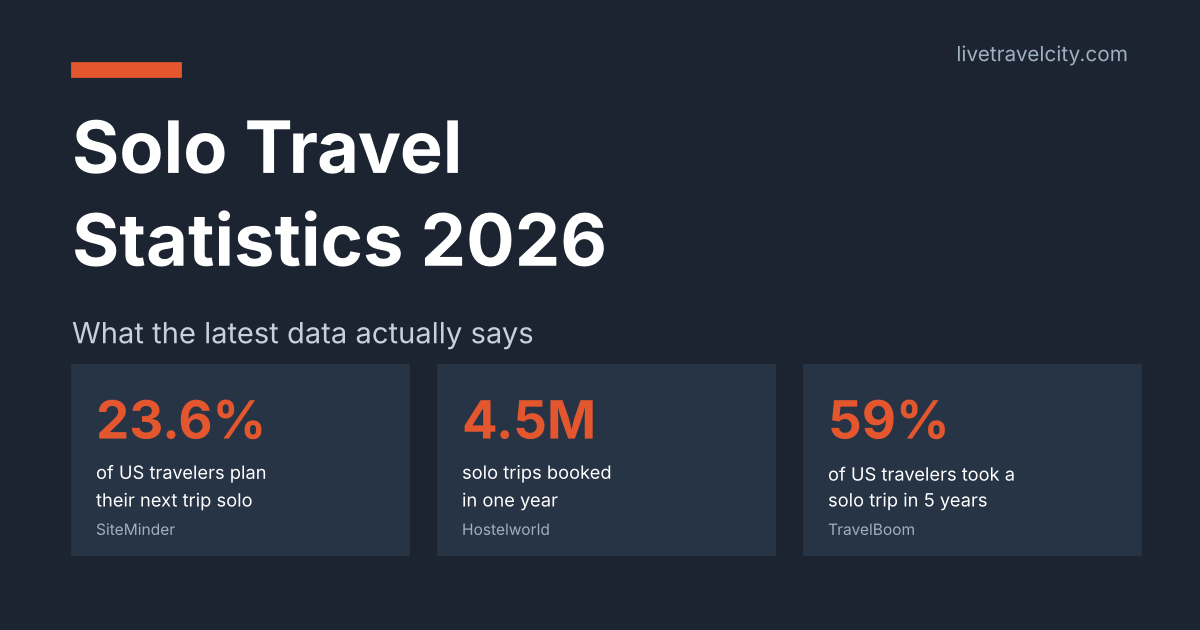
How many people travel solo in 2026? Studies published this year put the figure anywhere from 16% to 59%, depending on what each one measured. These are the headline numbers from the main 2026 studies.
Those figures range from 16% to 59%, and the next section explains why.
Each study asks a different question, and the wording, the time window and the people surveyed all change the answer. Before you quote a solo travel number, check which of those it reflects.
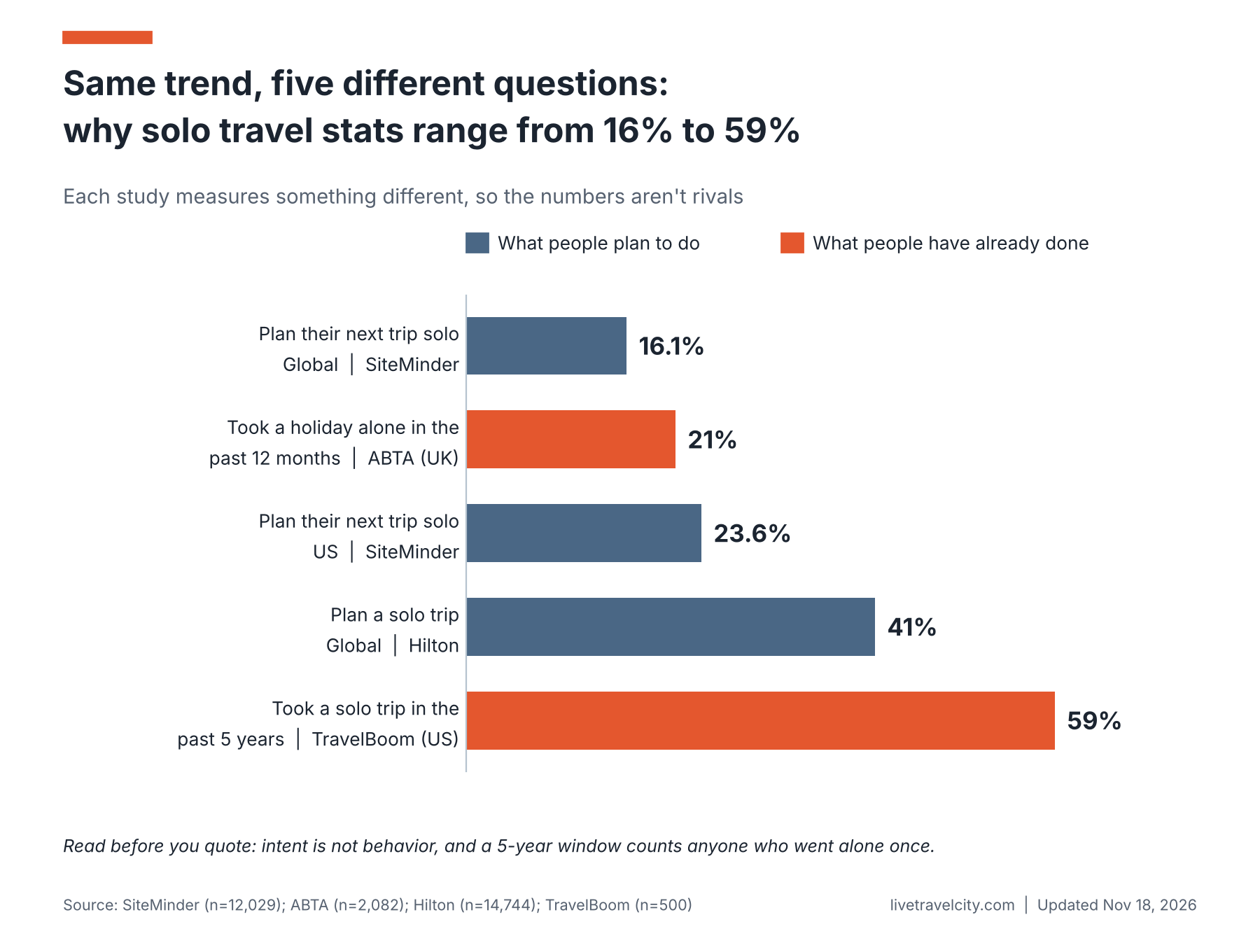
Chart: livetravelcity.com. Free to embed with credit and a link to this page.
SiteMinder asked travelers how they plan to take their next trip, which gave 23.6% in the US and 16.1% globally. That is intent, not bookings, and SiteMinder says so itself. Hilton’s 41% asks who plans a solo trip in the coming year. A person can take a solo trip and a family trip in the same twelve months, so it runs higher than a “next trip” figure. Hilton’s separate 31% is a different kind of number altogether, because it counts travelers who have already gone solo to meet people they know.
Behavior figures look different again. ABTA’s 21% counts UK respondents who took a holiday on their own in the previous 12 months, in a nationally representative sample, which makes it one of the sturdier numbers on this page even though it covers only the UK. TravelBoom’s 59% counts anyone who has gone solo at least once in five years, so a single long weekend alone puts you in the count.
Then there’s who answered. Hostelworld surveys people who book hostels, which skews young. Solo Traveler World’s reader survey leans heavily toward women over 55. Both are real data, and neither describes the average traveler.
The same gap shows up inside one demographic. Booking.com’s 2024 survey found about 65% of Indian Gen Z respondents had traveled on their own in the previous six months, while Agoda’s 2026 Asia survey put Indian Gen Z solo trips at 22%. The wording, time window and sample all differ, so both can be true.
The old picture of a twenty-something with a backpack is only part of it now. In Hostelworld’s 2026 data, 65.8% of solo travelers are aged 18 to 30 and 59.3% are women, and about 19.7% identify as LGBTQIA+ (up from 18% in 2025). Hostelworld also found that 7.9% of its solo travelers take ten or more solo trips a year, while 15.8% tried it once and say they won’t travel any other way. Experience changes behavior, too: about 35.8% of frequent solo travelers avoid trending spots, compared with 11.6% of first-timers. Africa was its fastest-growing source region, up 16.4% in a year, though it still makes up only 1.7% of bookings.
Beyond the hostel crowd, solo travel is moving into mid-life. SiteMinder found Gen X added 3.1 points of solo share and millennials 3.0, with faster growth among women (+2.9 points) and the strongest gains among adults in their thirties, forties and fifties. Globally, solo travel now ranks as the third most common way to travel, ahead of traveling with friends.
Gender is the figure most often misquoted. You will see claims that 80%-plus of solo travelers are women, and a 2026 Intrepid Travel feature carries the headline that up to 85% are. Those numbers come from audiences that skew female, such as tour-operator customers and reader surveys. Hostelworld’s booking data puts women at 59.3%, and SiteMinder shows the gap narrowing. The direction can even flip: a 2022 TravelPulse figure, repeated on several roundup pages, had 30% of male travelers likely to travel alone against 19% of female travelers. Women lead in most 2026 data, but the size of the lead depends on who you ask, and men are the least studied group.
Control over the schedule comes up more than any other reason in the 2026 data.
Opodo and eDreams are sister brands of eDreams ODIGEO, and their releases are the UK and US cuts of one global survey of 9,000 adults (2,000 per market), so we count them once.
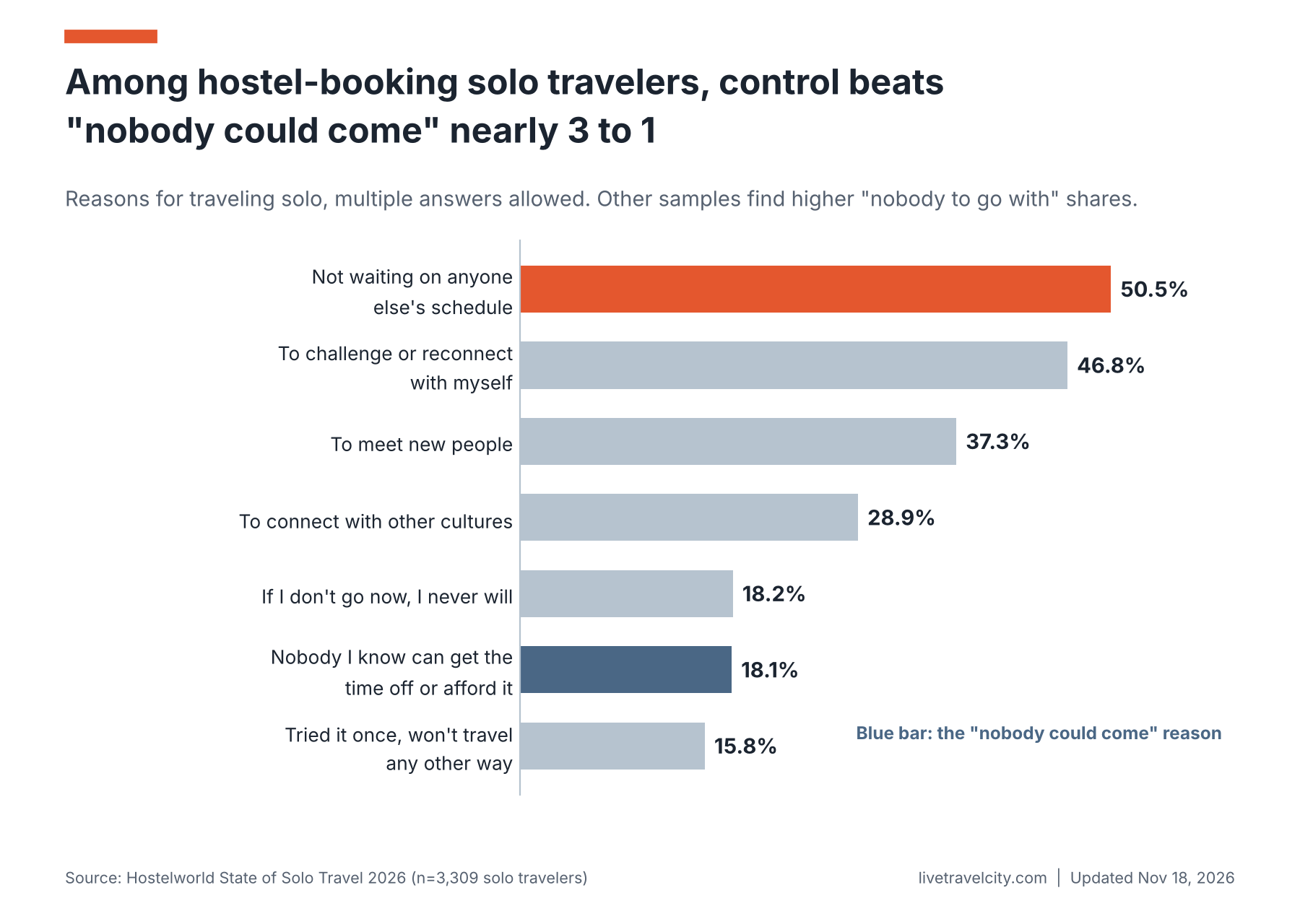
Chart: livetravelcity.com. Data: Hostelworld State of Solo Travel 2026.
Under30Experiences, a travel company for young adults, offers a counterpoint: 62% of its travelers booked solo but only 13% preferred it from the start (The Social Travel Gap, 2026). That combines the company’s own booking data with an alumni survey, so it is directional at best, but it fits eDreams’ finding that 38% of Americans cite unavailable friends or family.
Hostelworld’s 4.5 million trips give the cleanest destination data available this year, with one caveat: it covers hostel bookers only.
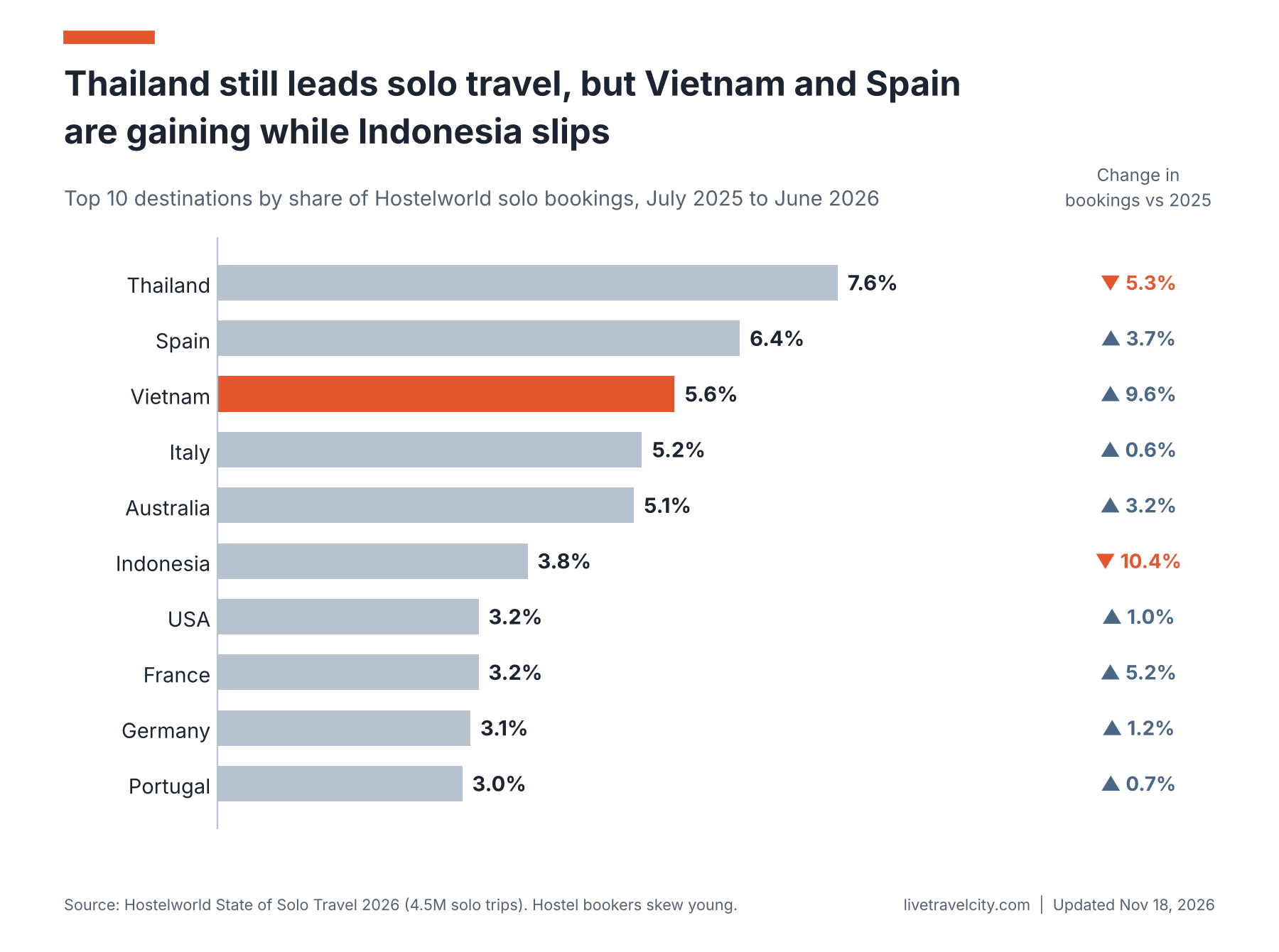
Chart: livetravelcity.com. Data: Hostelworld State of Solo Travel 2026.
The 2026 top five by share of solo bookings:
The growth is elsewhere. China grew 80.7% in a year, but from a small base (it sits 49th), so the rate says more about direction than size. El Salvador rose 47.6%, Albania 27.9%, Montenegro 27.2% and Sri Lanka 21.2%. Hostelworld calls the Balkans the new Croatia, which fell 4.7%. The classic Southeast Asia trail is wobbling: Vietnam and Laos grew while Cambodia, Indonesia, the Philippines, Malaysia and Singapore shrank, and Hostelworld says more stops on the route are now shrinking than growing, a first.
The US is a split story. Trips into the USA by non-Americans fell 9.1%, with the Netherlands (down 34%) and Switzerland (down 32%) cutting the most, while solo travel by Americans inside their own country rose 17.6%. That domestic growth is the only reason the USA still ranks seventh. Indian travelers were the exception, with trips to the USA up 21%, and domestic solo travel rose in 11 of the 15 largest source markets.
On the wish list, Spain leads at 15.3% and Japan fell from first to fifth. Brazil is seventh on the wish list but 21st in actual bookings.
And what about everyone who isn’t a backpacker? Solo Female Travelers found 62% of respondents recommend a European country for a first solo trip, with the UK, Italy, Spain, Iceland and Ireland leading. It also found 16% recommend their own country, a figure that hasn’t moved since the survey began.
Data from these regions is thin. Most published solo travel research comes from European and American companies, and Asia, Africa and Latin America are underrepresented. What exists:
A solid solo travel survey of Asian, African or Latin American travelers would fill an obvious gap, and it would get cited.
Going alone usually costs more per person, and operators have been slow to change how they price it.
The single supplement [the surcharge for occupying a double room or cabin alone] is still common. No study measures its size across the industry. Commonly cited ranges run from 25% to 75% of the per-person rate, and up to 100% on some cruises (Travelers Today, which doesn’t name a source for the range). The same piece reports a few operators going the other way in 2026: Rick Steves caps the supplement at a flat $50 a day, Tauck waived it on some European river cruise cabins, and a Botswana lodge dropped it entirely. Check each operator’s current policy before relying on any of that. In the Solo Female Travelers survey, 32% want the industry to stop charging solo travelers more, 68% of women who have traveled solo worry about higher costs compared with splitting them, and 73% of those who haven’t yet cite cost as a barrier. For readers put off by those extra costs, we have a separate breakdown of ways to save money on travel that helps offset going without a roommate or travel partner.
On the traveler side, Hostelworld found 51% choose dorms over private rooms, 27.5% cook instead of eating out, 26.2% book fewer paid tours and 25% travel off-season. Only 15.9% say nothing has changed. At hotels, SiteMinder found 55% of solo travelers worldwide choose a standard room, versus 43.3% of all travelers, and 7.5% book right before check-in, compared with 4.2% overall.
Go2Africa’s Luxury Solo Travel Report claims solo travelers spend 42.8% more per person than couples. It’s a luxury safari operator’s own report, so it speaks for high-end travelers only.
Booking behavior has fresh data this year, while spending data is much thinner.
Hostelworld asked 3,309 solo travelers what influences their booking (multiple answers allowed):
On planning, Go2Africa’s own customer data says 81.18% of solo travelers have a clear destination in mind before booking and 30.1% prefer trips of about ten days, though that is a luxury safari operator’s customer base. Remote work is still a minority habit: only 4.5% of 18-to-25-year-old solo travelers mix work and travel, rising to 11.7% for ages 36 and over and to 20.8% among those taking ten or more solo trips a year. Another 34.6% say they don’t but want to (Hostelworld).
Spending is harder to pin down. We couldn’t find a free, current, named study that reports it, and the 2026 studies we could read measure how people cut costs, not how much they spend. Broader trackers do publish spending, but not for solo travelers specifically: MMGY’s fall 2026 survey of US adults, for example, projects about $5,655 of leisure travel spend per person over the next year, with Boomers at $8,796 and Gen Z at $2,195 (via Travel Age West). Paid analyst reports from firms such as Phocuswright or MMGY may break solo travelers out, and we haven’t seen them. The solo-specific dollar figures that circulate for free are mostly the Go2Africa claim above, older Statista bands from 2023, or tables on blogs that don’t name a survey or a sample. A few pages claim averages as high as $18,000 per trip without linking a method. Until a named study publishes spend per trip, we wouldn’t quote one.
Safety concerns show up mostly in how people travel alone: what they pack, where they sleep and whose advice they trust.
Whose advice do they trust? Hostelworld found 44.5% turn to friends who’ve been there, and 38.1% to hostel staff and other travelers on the ground. Only 4.8% trust official tourism sites. Creators on TikTok or Instagram and AI chatbots each get 4.5%, though offline maps and safety-sharing tools remain travel apps worth installing before you go.
Many solo travelers are not alone for the whole trip, and that may be the most interesting shift in the 2026 data.
That makes the old “solo versus group” split a poor fit for what people actually do. Many want independence with a safety net.
Market research firms publish very different totals for the same year.
These are modelled projections. If you cite them, call them estimates and name the firm.
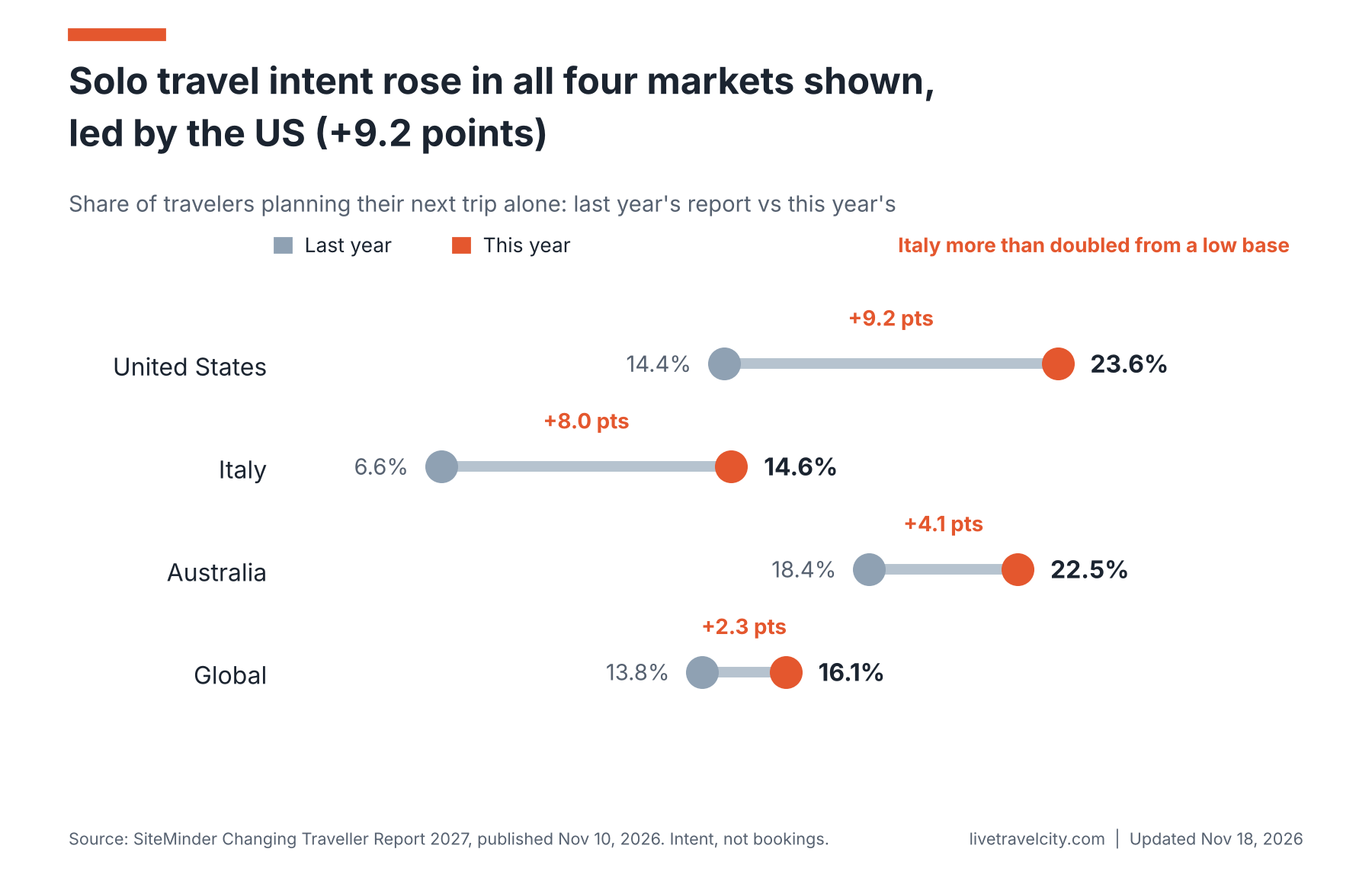
Chart: livetravelcity.com. Data: SiteMinder Changing Traveller Report 2027. Intent, not bookings.
Several figures keep circulating long after the context that made them meaningful has gone. A few to check before you quote them:
If a figure has no year and no named study behind it, leave it out.
Who ran each study, how many people it reached, and what that means for how far to trust it:
Most of these studies come from companies that sell travel. That doesn’t make the data wrong, but the sample size and who was asked should come before the headline number.
The 2026 data describes at least four kinds of solo traveler. Younger travelers are choosing hostels and cheap flights, mid-life travelers are adding solo trips to busy lives, women over 50 are booking small-group tours, and “solo-ish” travelers go alone but arrange to meet people. They behave differently, spend differently and worry about different things.
Across the studies, going alone is rarely described as a fallback. Most of Hostelworld’s respondents chose to travel alone, and Hilton says 92% of the travelers planning a solo trip in the next year have taken one before (Hotel Management).
Using these numbers: please link to the original study for any individual figure. If you cite our roundup, link to this page and mention the date, since we update it as new data arrives. The charts above are free to embed with credit to livetravelcity.com and a link back.