Physical Address
304 North Cardinal St.
Dorchester Center, MA 02124
Physical Address
304 North Cardinal St.
Dorchester Center, MA 02124

Buying mobile data abroad used to mean a queue at an airport kiosk. These days it takes a QR code and about two minutes. The hard part is choosing. Dozens of providers promise “unlimited,” and almost every “best of” list crowns a different winner.
A travel eSIM is a prepaid data plan you install on your phone with a QR code or an app instead of a plastic card. It’s a SIM built into the phone and switched on with software, and it runs alongside your regular SIM, so you keep your number while a second line handles data abroad.
Our pick for most trips is Airalo: it covers the most places, states its fair-use rules plainly, and puts no limit on tethering. For a first trip, Saily comes a close second, mainly for its built-in security extras. The full list:
The ranking rests on what providers publish in their own plan pages, help articles and terms, cross-checked against independent comparisons. Nothing here was bought or speed-tested by us, so every speed and price is as the provider prints it, checked in mid-to-late November 2026. When two sources disagree, the text says so.
Three things decide whether an eSIM suits you: the price for the data you’ll actually use, the daily speed rules on “unlimited” plans, and the hotspot terms. Many providers resell capacity on the same local networks, so signal quality is often similar from one to the next. That’s why the list weighs clarity of terms, coverage and fit rather than a speed test.
Airalo sells plans for 200+ countries and regions, mostly priced by the gigabyte. Its own help pages say unlimited plans give you 3 GB of fast data per 24 hours and then slow to 1 Mbps until the clock resets, with the day counted from your first connection. The regional Europe plan, Eurolink, is listed at 5 GB a day. Tethering has no device limit, but shared data comes out of the same daily allowance. For a few destinations, including the US and Canada, you can also buy a plan with calls, texts and an Airalo phone number, which adds roughly a third to the price.
On November 15, a 7-day unlimited plan for Japan was listed at $26.50. A 10 GB fixed plan for the same week was $17.
Two things to watch. Airalo’s fair-use policy lets it suspend or restrict a plan without notice if it believes you’re misusing it, and in Japan the daily figure only appears once you’ve picked a package.
Saily comes from Nord Security, the company behind NordVPN, and covers 200+ destinations. The plan card prints the numbers up front: 5 GB a day at full speed, then up to 1 Mbps. Every plan includes ad and tracker blocking and web protection, and there’s an optional US number for calls and texts. A 7-day unlimited plan was listed at $26.99 for both Japan and Europe.
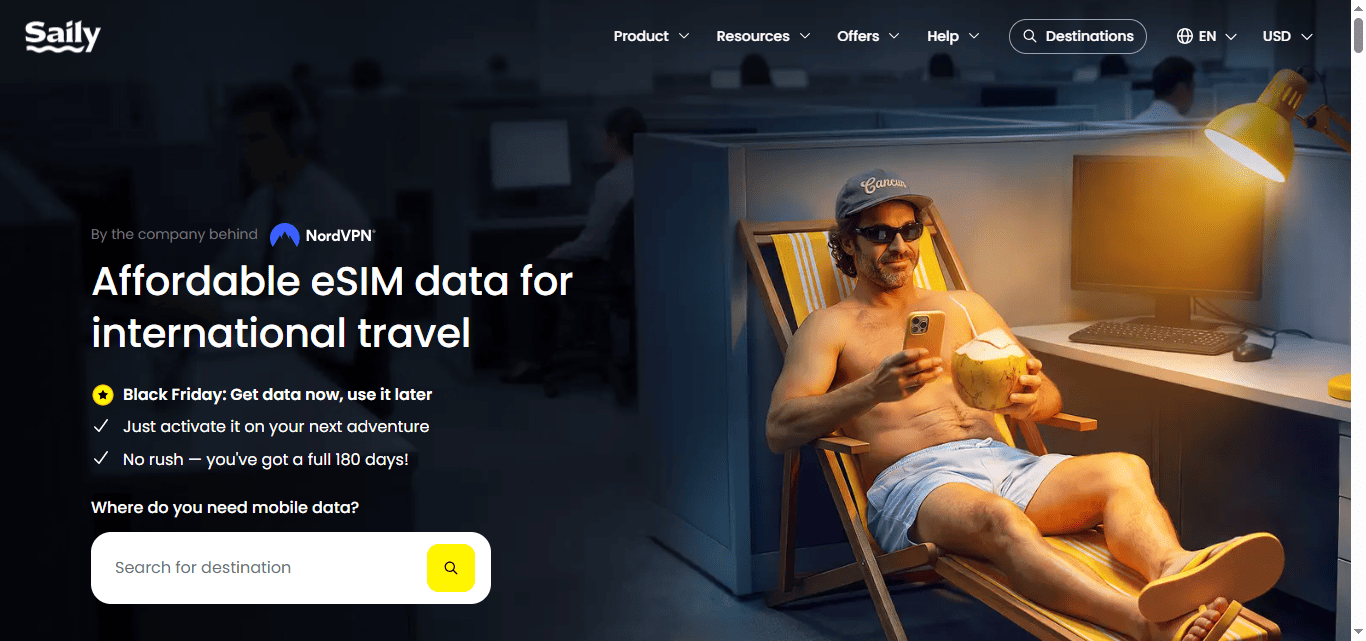
The protection is lighter than a full VPN, the kind of service that routes all your traffic through an encrypted private server, so don’t treat it as one. Hotspot sharing is the bigger question. The plan tabs call it unlimited, but the terms bar sharing with several devices or people beyond occasional personal use, and they never give a number. If you plan to tether for hours at a time, read the terms before you pay.
Holafly is for people who’d rather not watch a meter. You choose a number of days, you get unlimited data, and the app is easy to use. A 7-day plan was listed at $27.50 for both Japan and Europe. In October 2026 it added Ultra, a monthly plan from about £72 that bundles unlimited data with a local phone number, guaranteed SMS reception, and travel and medical support services. It’s aimed at people who are on the road constantly.
The word “unlimited” deserves the closest look here. Holafly’s own help pages say a fair usage policy can slow your speed after heavy use, and that the slowdown lasts no more than a day. On the pages read, though, Holafly didn’t print a daily figure, and reviewers report thresholds that vary by destination. Hotspot is a separate allowance, reported at 1 GB a day (7 GB on a 7-day plan). Some roundups describe Holafly as having no throttling at all, which doesn’t match its own help pages, so check the technical specs for your destination before buying.
Most of Ubigi’s “unlimited” plans aren’t daily allowances at all. They sell a fixed total of fast data for the whole trip: roughly 25 GB for a 7-day Europe plan and 30 GB for 15 days, then about 2 Mbps. The exception is its 8-day Japan plan, at 5 GB a day. A 7-day Europe plan was listed at $23, the lowest of the group, and Ubigi says there are no hotspot restrictions.
Ubigi is backed by Transatel, part of Japan’s NTT group, and sells local, regional and global plans across 200+ destinations, including Nepal on the Ncell network. Thirty gigabytes over 15 days works out to only about 2 GB a day, the smallest total among the 15-day plans compared, so heavy users will run out first.
Nomad suits people crossing several borders or staying a few weeks. It sells fixed-data plans, unlimited-style day plans and regional and global bundles across 200+ destinations, with hotspot support. Some global plans run for up to a year, which helps on slow travel. A 7-day unlimited plan for Japan was listed at $25, and a 10-day Europe plan at $34.
The plan panels print 2 GB a day at full speed, which is less headroom than most rivals. Speed after the cap is listed as 1 Mbps on some plans and 512 kbps on others. Which? has said Nomad has no fair usage policy, which doesn’t match the panels, so trust the one on the plan you’re buying.
Roamless runs a single global eSIM profile that you top up with credit, charged by the gigabyte. The credit doesn’t expire, which is the whole appeal for anyone who dislikes expiry dates. In October 2026 it added unlimited plans too: 3 GB a day at full speed, then 1 Mbps, from about $8.40 for a day up to roughly $351 for 90 days. A 7-day Japan plan was listed at $23.52, the lowest unlimited price among the main providers compared.
It prints the daily numbers on every destination page before you choose. Its help article also says that when you hit the daily limit, the app offers to switch to a data plan or to credits you already hold, and asks before spending anything.
Jetpac’s odd extra is SmartDelay. According to Jetpac’s own help center, if your flight is delayed by an hour or more you get free airport lounge access. You register the flight in the app at least 24 hours before departure, and each data pack covers up to two flights.
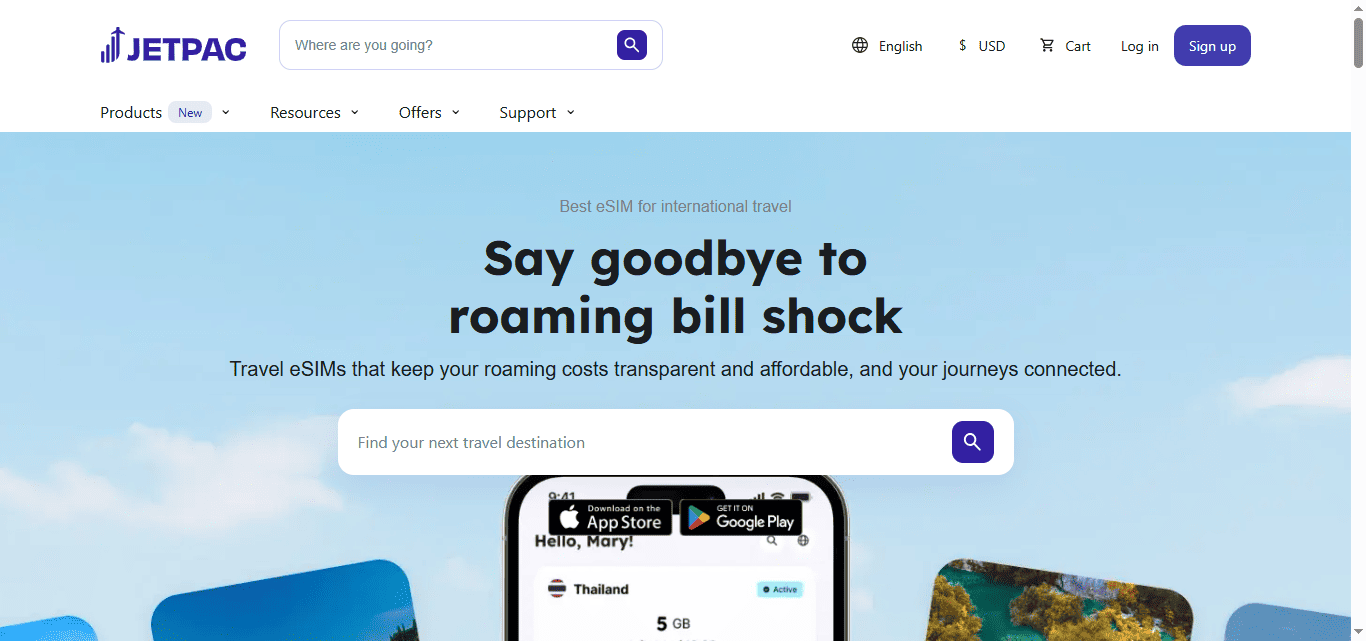
Its unlimited plans come in several lengths, from a few days up to 30, with 3 GB a day at full speed before dropping to about 1 Mbps. Prices vary by source and destination, so check the live plan: the 30-day unlimited plan was listed at $65.99 on Jetpac’s Europe page, and the shorter plans cost less.
Perks only matter if you use them, so compare price per gigabyte first.
aloSIM offers per-gigabyte plans and some unlimited options at prices close to Airalo’s and Saily’s. A 7-day unlimited plan was $27 for both Japan and Europe. A popup behind a “See limitations” link says 3 GB a day, then 1 Mbps, but the terms say 512 kbps and let the company change the allowance at any time, so read the terms, not just the popup. Hotspot is allowed for your own devices and travelling party. An optional calling number comes through its sister app, Hushed, and becomes a paid subscription after a trial.
Cruise ships run their own satellite networks, which an ordinary travel eSIM generally can’t use at sea. CNBC Select’s roundup points to GigSky’s combined cruise-and-land plan, which it says works in 134 countries and on more than 200 ships from lines including Carnival, Celebrity, Disney and Royal Caribbean.
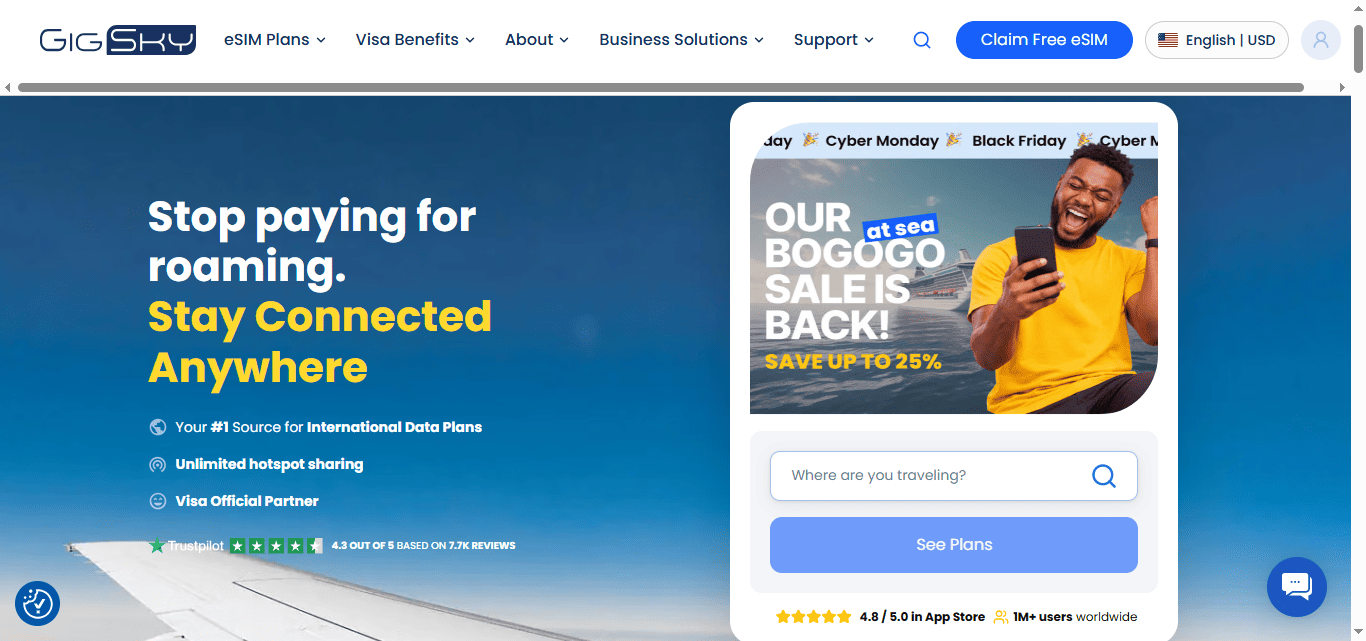
GigSky’s unlimited data page lists up to 3.5 GB in 24 hours, though its own pages disagree about when that resets, and its refund FAQ says case by case. Check that your ship and itinerary are covered before relying on it, and see our cruise packing list for what else to bring.
Wise sells eSIMs inside its app, under Cards and then Travel Hub, covering 150+ destinations. You set it up once and reuse it on later trips. Coverage is smaller than the specialists’, so compare per-gigabyte prices against Airalo or Saily for your destination. Revolut is also worth a look if that’s the app you use.
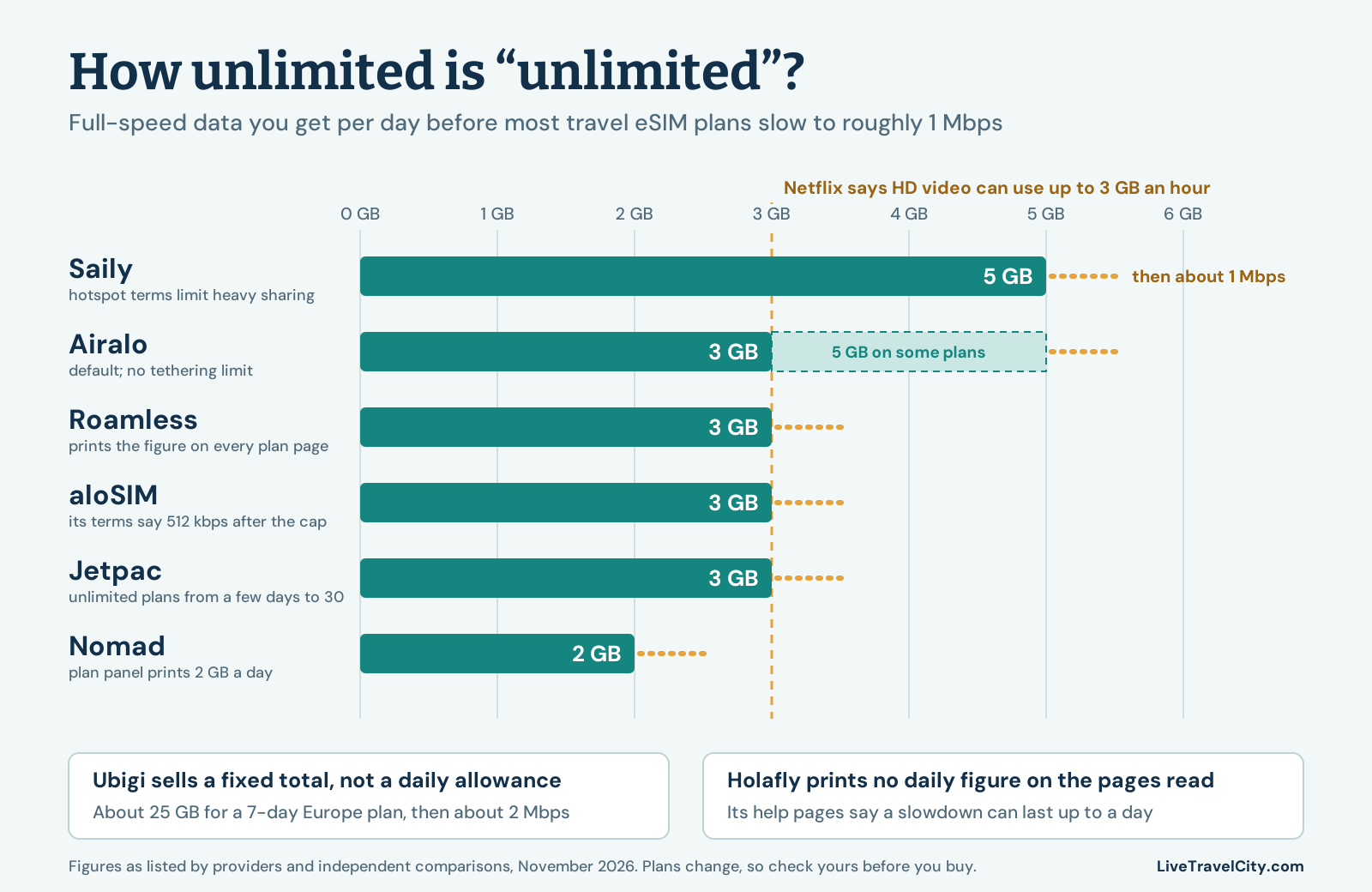
Almost never unlimited speed. In one independent comparison of 14 sellers, read on November 15, eight printed a daily fast-data figure on every unlimited plan they compared, and on most it was between 2 GB and 5 GB a day, with speeds dropping to about 1 Mbps afterward. The providers’ own numbers line up:
Is 1 Mbps usable? For maps, messaging and email, yes. For video it isn’t: Netflix says HD needs about 3 Mbps, and an HD video call needs more than 1 Mbps. If you share your connection, that usually comes out of the same daily allowance.
Often. On November 15, Airalo’s 7-day Japan plan was $26.50 unlimited versus $17 for 10 GB fixed. That fixed plan works out to about 1.4 GB a day, so if your use fits, you save $9.50. Ericsson’s June 2026 mobility report puts average mobile data use at 22 GB a month worldwide, around 0.7 GB a day, which sits comfortably inside a fixed plan.
Unlimited makes sense when you stream video, share your connection or simply hate counting. Netflix says HD video can use up to 3 GB an hour, so streaming alone can eat a 10 GB plan quickly. If you mostly use maps, messaging and social media, buy fixed. If you live on video, buy unlimited and read the daily cap.
Usually. Which? reports that roaming charges from the big UK networks tend to be significantly higher than a travel eSIM. In the US, Verizon’s TravelPass costs $12 per line per day, which is $84 for a week, against roughly $23 to $27 for a week of eSIM data in the examples above. Some carriers do include international data, though: Google Fi’s Unlimited Premium plan, at $65 a month, includes up to 50 GB of international high-speed data in 200+ destinations. Apple’s own guidance for iPhone users starts with the same advice, which is to check what your carrier already includes before buying anything.
The real comparison has three sides: your carrier’s roaming or travel pass, a travel eSIM, or a local SIM or eSIM from a carrier in the country you’re visiting. On a long stay in one place, the local option is often the best value and comes with a local number.
Once an eSIM plan is active, refunds are rare unless the fault is the provider’s. Several providers say they’ll refund a plan that fails because of their own error or the local network, but an installed plan counts as used if you simply change your mind, and some plans are explicitly non-refundable. Most providers’ terms also let them suspend or restrict a plan they believe is being misused, in some cases without notice or a refund. So check phone compatibility and carrier-lock status before you buy, and don’t use an unlimited plan for anything the terms rule out, such as running a business or heavy continuous tethering.
Most recent phones do. Apple says you need an iPhone XS, XS Max, XR or later, and newer Pixel and Samsung Galaxy models also support eSIM, though some regional variants don’t, so check your exact model. A quick test on most phones is to dial *#06# and look for an EID, the long number that identifies the phone’s eSIM chip. If there’s no EID, there’s no eSIM.
Do it before you leave, on Wi-Fi, because installing needs an internet connection and an arrivals hall at midnight is a bad place to find that out.
On a recent iPhone, iOS 26 makes this easier. Buy a travel eSIM before you leave and your phone may ask whether it’s for home or travel, then offer to switch it on when you land, either alone or alongside your current line. When you return home it can switch back automatically, depending on your country or region. FaceTime and iMessage keep working on your home line if you use the travel eSIM alone, and Apple adds that an eSIM can’t be pulled out of a lost or stolen phone the way a physical SIM can.
In towns, yes; on a trail, don’t count on it. In Nepal, the two main networks are Ncell, a private operator, and Nepal Telecom (NTC), the state carrier. Ncell sells its own tourist SIM and eSIM that can be activated with a passport, and several global providers, including Airalo and Ubigi, list Ncell as the network their Nepal plans run on. Local travel guides say NTC tends to reach further into the hills, where commercial coverage thins out. That pattern holds in many mountain regions: the eSIM is only as good as the local network behind it.
So buy connectivity for the towns and teahouse stops where signal exists, download offline maps before you go, and don’t plan a trek around being reachable at altitude. For a longer stay, a local SIM from Ncell or NTC may beat any travel eSIM on value.
Five questions settle most cases:
For a short list: Airalo for most trips, Saily for a first trip, Roamless if you dislike expiry dates, Nomad for slow travel, and Holafly if you want to pay by the day and stop thinking about gigabytes. Prices shift with the country and the amount of data, so no list can crown a permanent winner. Compare the exact plan for your trip before you buy.
With your data sorted, the next job is loading your phone, and our list of the top travel apps covers maps, translation and booking.