Physical Address
304 North Cardinal St.
Dorchester Center, MA 02124
Physical Address
304 North Cardinal St.
Dorchester Center, MA 02124

I found out my curling iron was a fire hazard the same way most people do: by watching a security agent lift it out of my bag, hold it up like evidence, and drop it into a bin I would not see again until disembarkation day. I hadn’t hidden anything. I hadn’t even known it was a rule. I just assumed that if an item was fine on a plane, it was fine on a ship. It is not, and nobody had told me otherwise.
That’s the thing nobody warns you about with cruises, the packing rules aren’t the same ones you’ve spent years learning for flights, and the ship won’t pause to explain that to you at the terminal. So does that mean you need to memorize a small legal code before you sail? Not quite. But it does mean a cruise packing list has one job a beach or city-trip list doesn’t: telling you what to leave behind, not just what to bring.
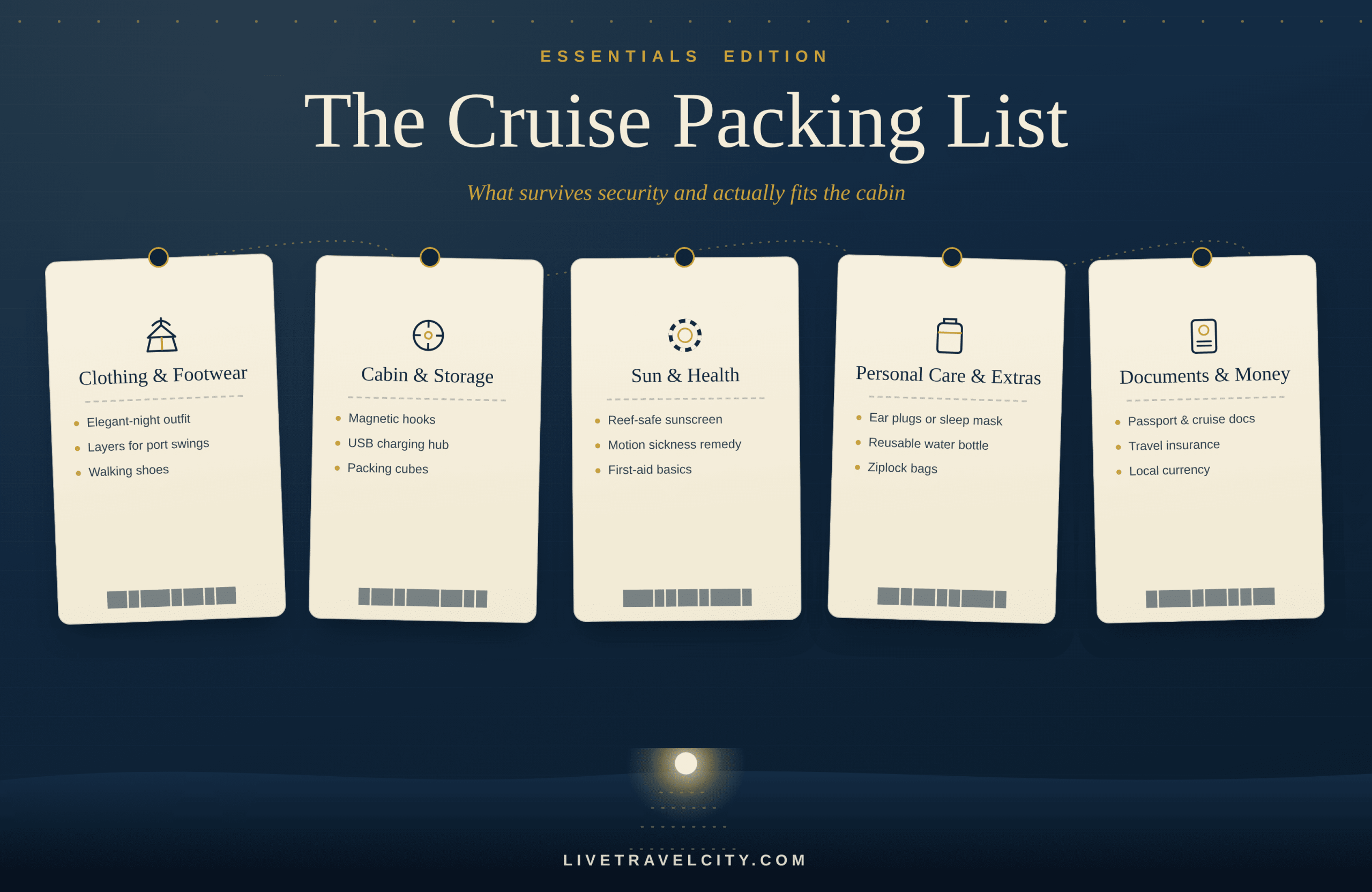
Here’s what actually earns a spot in a suitcase for a week at sea, and what gets left in a confiscation bin if you’re not careful.
Clothing and footwear
Cabin and storage
Sun and health
Personal care and extras
Documents and money
That’s the full shape of it. Now here’s the reasoning behind each category, plus the one section every other cruise list buries instead of leading with.
A cruise clothing list has to solve a problem a beach trip doesn’t: you’re not packing for one climate, you’re packing for several. A ship that leaves a chilly departure port can dock the next morning somewhere twenty degrees warmer, and the deck at 9 p.m. never feels like the pool did at 2 p.m. Layers do more work here than any single “essential” item.
The one wildcard is elegant night. Dress codes have loosened across most mainstream lines, but the term still means something different depending who you ask – for some passengers it’s a sundress, for others it’s the one excuse to pack a suit. Bring one outfit you’d be comfortable in either way, and you’ve covered it without dedicating a quarter of your suitcase to formalwear you’ll wear once.
Standard cruise cabins run smaller than almost any hotel room you’ve stayed in, and the storage rarely matches what you packed for. This is where cruise-specific gear earns its keep in a way nothing on a standard packing list does. Magnetic hooks work because most cabin walls are metal, which means you can hang towels, hats, and bags without touching a single drawer. An over-the-door organizer swallows toiletries and small electronics that would otherwise colonize the bathroom counter.
The charging setup deserves its own thought, too. Outlets in most staterooms are limited, sometimes to one or two, and rarely enough for everyone’s devices at once. A USB charging hub solves this cleanly – a power strip might seem like the obvious fix, but that’s exactly where the next section comes in.
Checked luggage doesn’t reach your cabin the moment you board. On most ships it can take several hours, sometimes not arriving until after dinner, and your cabin itself may not even be ready when you first walk on. Anyone who’s spent their first afternoon on board in travel-day clothes, wishing they’d packed differently, learned this rule the hard way.
The fix is simple: treat whatever bag stays with you through security, not your checked suitcase, as your first few hours’ survival kit. A swimsuit, a change of clothes, sunscreen, any medication you take, and your cruise documents belong in there. Everything else can afford to wait for your actual cabin.
This is the part every other cruise packing list treats as a footnote, and it’s the part most worth reading closely. Cruise ships operate under fire-safety and maritime rules that are stricter, and different, from what you’re used to at airport security. Items that fly through TSA without a second look can end up confiscated at the cruise terminal instead.
The categories that trip up first-time cruisers most consistently:
None of this is standardized across cruise lines, and it changes often enough that a list like this one can only get you most of the way there. The one habit worth building: check your specific cruise line’s prohibited items page a week or two before you sail, not the morning you’re packing.
Motion sickness sits at the top of this list more often than people expect, even from passengers who’ve never been seasick on a boat before – ships move differently than the lake trips or ferry rides most people benchmark against. Packing a remedy before you need one beats trying to track one down from the ship’s gift shop mid-swell.
Cash for ports is the other one. Not every stop takes cards easily, and gratuities [the daily service charge added to your onboard account, covering tips for staff across the ship] are usually billed automatically but small bills still come in handy for local vendors, taxis, and the kind of tipping that doesn’t run through your room key. A lanyard for that room key, meanwhile, solves a problem you won’t appreciate until the first time you’re standing at a pool bar with nowhere to put your card.
The tension in cruise packing is that a sea day and a port day want almost opposite things. Sea days reward whatever’s most comfortable – cover-ups, sandals, a book. Port days want something closer to a normal day-trip kit: a daypack, water shoes if there’s any chance of a beach excursion, and a dry bag if you’re doing anything on or near the water.
The fix isn’t packing two separate wardrobes. It’s picking pieces that work in both contexts – a swimsuit that doubles as excursion-ready under a cover-up, walking shoes comfortable enough for a ship deck and sturdy enough for a cobblestone port town and letting the daypack, not the suitcase, handle the difference between the two.
I never did get that curling iron back, ships don’t mail confiscated items, it turns out, they just hold them until you disembark and then it’s gone. I’ve since replaced it with a travel-safe version that won’t get flagged, which is either a small victory or proof that I still haven’t fully learned my lesson. Either way, it’s on the list now.