Physical Address
304 North Cardinal St.
Dorchester Center, MA 02124
Physical Address
304 North Cardinal St.
Dorchester Center, MA 02124

I have, on three separate occasions, arrived at a beach without a swimsuit. Once I packed seven paperback novels and zero pairs of underwear. Another time I brought a hardcover cookbook for a five-day trip where the only kitchen I saw was the one at the resort buffet. I am, by every reasonable measure, bad at this.
And yet I keep getting asked for packing advice, mostly because I’ve made every mistake there is to make and lived to write about it. So does over-preparing for the wrong things count as a system? Maybe not. But after enough disasters, you start to notice which items you actually reach for every single day, and which ones just take up suitcase space so they can come home exactly as clean as they left.
That’s what this is: not a fantasy list of everything a beach vacation could theoretically involve, but the stuff that survives contact with an actual trip. Grab what applies to you and skip the rest, nobody needs to pack for a hypothetical scuba excursion they’re not taking.
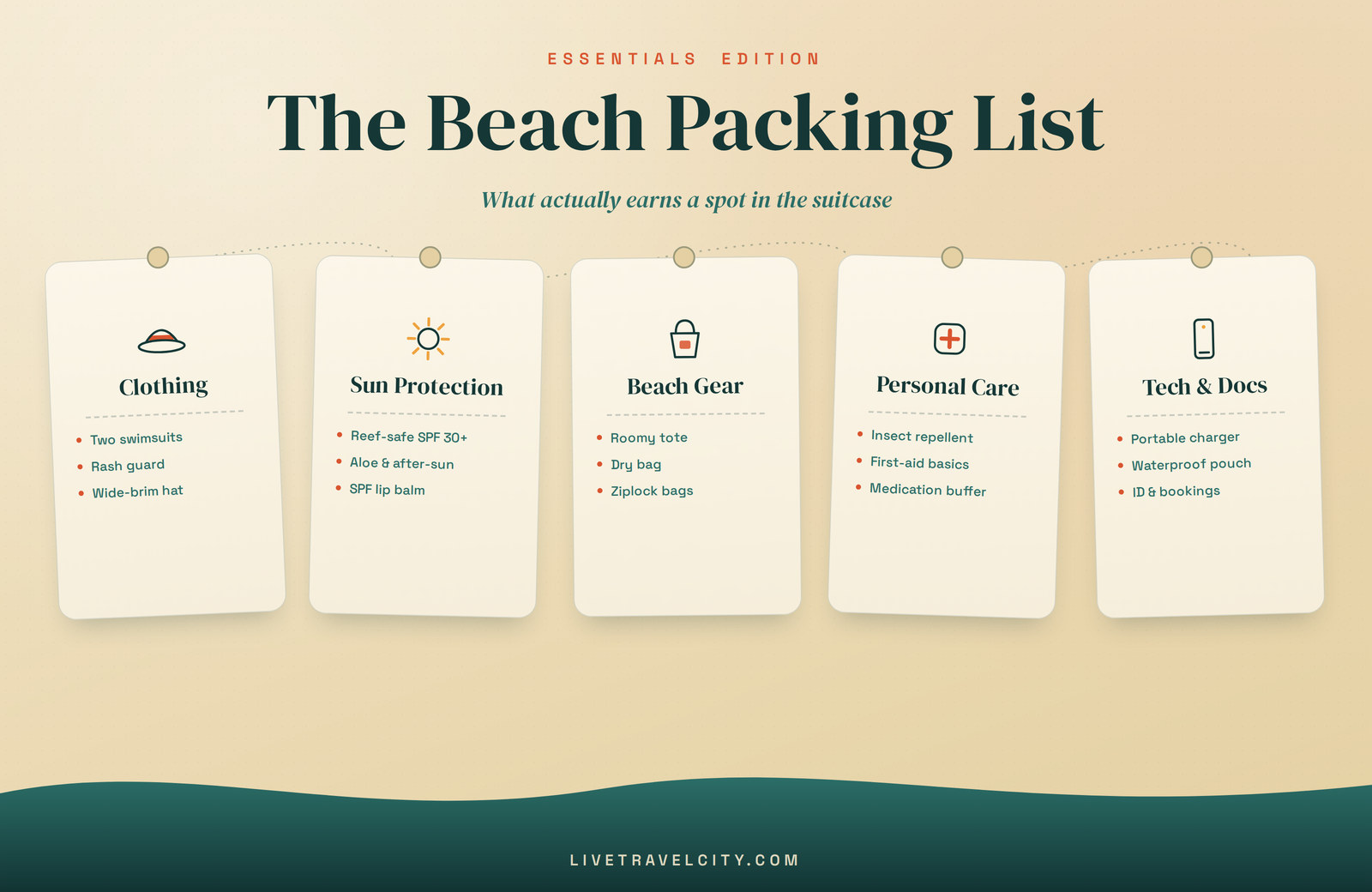
Here’s the complete rundown. Categories below go deeper on the “why” behind each pick.
Clothing
Sun and skin protection
Beach gear
Personal care and health
Tech and extras
Documents and money
That’s the skeleton. Now here’s what actually determines whether each of those items earns its spot and where the standard advice tends to go wrong.
Here’s a formula worth stealing before you fold a single shirt: count your tops, count your bottoms, and multiply. Four tops and three bottoms isn’t seven items – it’s twelve possible outfits, as long as everything’s built to mix and match. That kind of capsule wardrobe [a small set of clothing pieces designed to combine into multiple outfits] thinking is the difference between a suitcase that closes and one that needs someone sitting on it.
Where I’ve gone wrong before: packing for the beach I imagined instead of the one I was going to. That cookbook, for instance, was for a trip where I’d convinced myself I’d want to cook – I didn’t, and I never do. The fix is boring but it works: pack for the version of the trip you’ll actually take, not the ambitious one you’ll abandon by day two.
One clothing item that doesn’t get enough credit: something that isn’t beachwear at all. A single outfit for a dinner out or a travel day saves you from showing up to a nice restaurant looking like you just left the sand.
Sunscreen is the one item every list agrees on, and also the one people most reliably underpack. The standard advice – SPF 30 or higher, reapplied every two hours or after swimming, undersells how much you actually go through on a real beach day. A single travel-size bottle rarely survives more than one afternoon per person.
Reef-safe formulas matter for more than the ocean’s sake – plenty of resort pools and beach destinations have started requiring them outright, so it’s worth checking before you buy the wrong bottle and have to repurchase on arrival.
The unglamorous backup layer – aloe gel, after-sun lotion – earns its spot for the same reason a spare tire does. You hope not to need it. You’re relieved when you do.
Start with the bag itself – an actual beach bag or tote, roomy enough for a full day out, saves you from stuffing everything into whatever tote happened to be on the counter at home.
This is where packing lists tend to sprawl into fantasy territory otherwise, listing gear for beach days nobody’s actually planning to have. Skip the umbrella and the folding chairs if your destination rents them on-site, which most popular beaches do. What’s harder to rent, and worth bringing yourself: a dry bag for your phone and cash, a handful of ziplock bags for anything smaller and sandier, and a mesh bag for the walk back with wet, sandy everything.
That second one sounds minor until you’ve spent a flight home smelling like a swimsuit that never fully dried. Separating wet gear from the rest of your luggage isn’t a luxury – it’s the difference between unpacking a normal suitcase and unpacking a biohazard.
Toiletries barely make it onto most beach packing lists, on the theory that nobody needs reminding to bring a toothbrush. Maybe not. But a beach trip has its own version of self-care that a normal weekend doesn’t: skin that dries out faster between salt water and sun, bug bites that show up right around sunset when the breeze dies down, and the occasional scraped foot from a shell nobody saw coming.
A small first-aid kit covers the last one – bandages and antiseptic wipes take up almost no space and get used more often at the beach than anywhere else on a trip. Insect repellent is the item most likely to get left home entirely, right up until the first mosquito bite at golden hour reminds you why it was on the list in the first place.
If you take any regular medication, a beach trip is an easy place to underpack it. Bring a few extra days beyond your trip length, delayed flights and extended stays happen more at leisure destinations than anywhere else.
Most “extras” sections on packing lists are padding, items nobody actually reaches for. The ones that survive repeated trips are narrower than you’d think: a portable charger, because beach days run long and phones don’t; a waterproof pouch, because sand and screens don’t mix; and something to read or watch that doesn’t need a strong signal, because beach wifi is a myth most places still haven’t caught up to.
Everything else – the speaker, the specialty snorkel gear, the second pair of sunglasses “just in case” – is optional weight. Bring it if it’s genuinely part of your plans, not because a checklist told you to.
The category nobody covers well is the boring one: documents and backup plans. A photo of your passport saved to your phone. A second payment method that isn’t in the same pocket as the first. A printed copy of your hotel confirmation for the one time your phone dies at check-in.
None of this is exciting to pack. All of it is the difference between a minor inconvenience and an actual bad day, which is a more useful test for what belongs on a beach packing list than “does it look nice in a flat-lay photo.”
The trick that’s saved me more suitcase space than anything else: wear your bulkiest shoes and heaviest layer on the plane instead of packing them, and fill every empty shoe with socks or chargers instead of leaving that space wasted. Packing cubes [small zippered fabric pouches that compress and organize clothes inside a suitcase] help too, mostly by forcing you to see exactly how much you’re bringing before it’s too late to edit.
I still haven’t gone an entire trip without forgetting something. Last time it was a hairbrush; the time before, phone chargers, both of them, for two different phones. But I’ve stopped forgetting the things that actually matter which, it turns out, was the whole point of building a list in the first place.