Physical Address
304 North Cardinal St.
Dorchester Center, MA 02124
Physical Address
304 North Cardinal St.
Dorchester Center, MA 02124

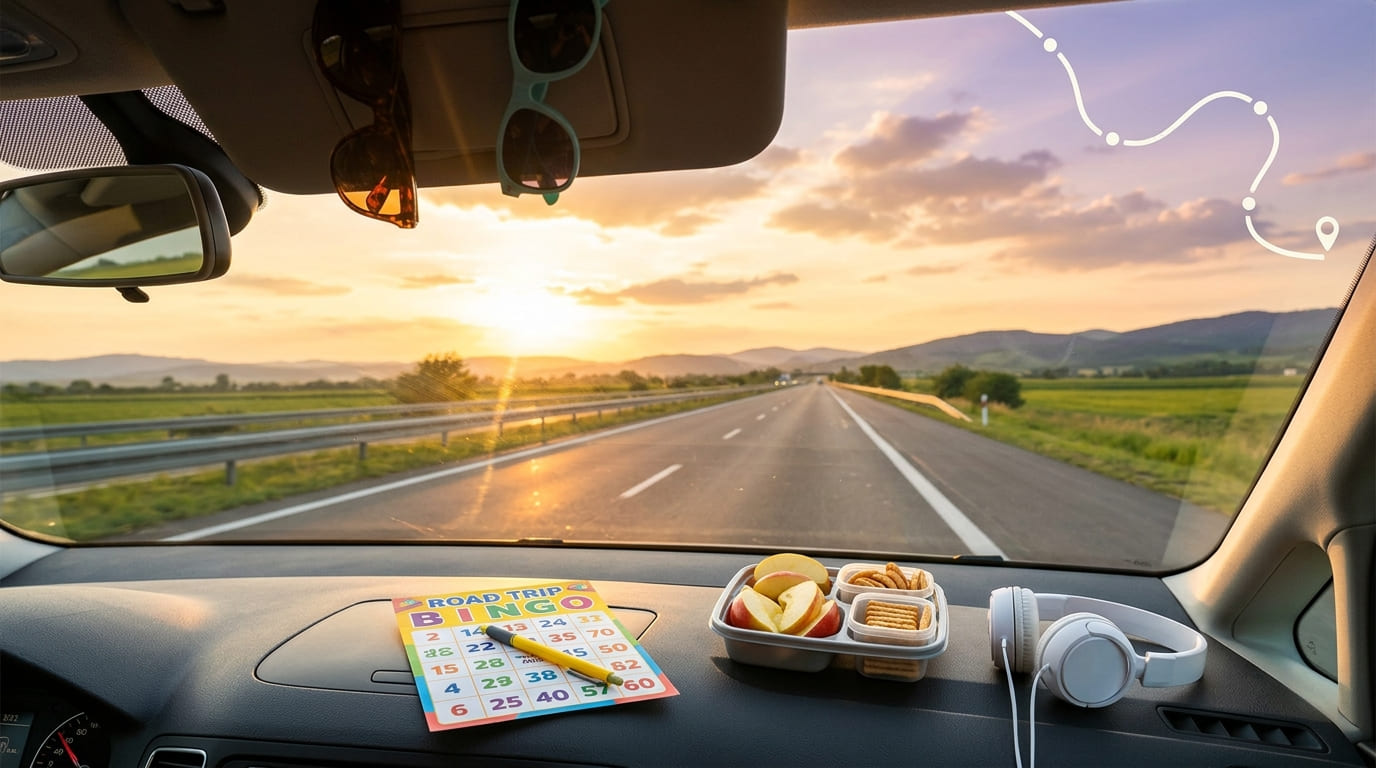
I once spent an entire evening building the Ultimate Road Trip Activity Kit. Laminated bingo cards, a sticker book, and markers labeled “washable” in a font far too confident. Eleven miles out of town, the markers had found the upholstery, the sticker book had vanished under a seat, and the smallest passenger announced, with a judge’s calm, that he was about to be sick.
So much for the kit. The best road trip activity, it turns out, is whichever one suits the person in that seat, and the driver plays by different rules. That’s how the 35 ideas below are sorted: by who’s in the car, and tagged for driver-safe, eyes-up and prep time.
Three questions separate the good ideas from the backfires.
Can the driver do it? AAA’s family road trip guidance is blunt: drivers should skip anything that takes their eyes off the road, their hands off the wheel, or their mind off the task of driving, and passengers shouldn’t unbuckle or wander around the car to play. That rules out most written games for whoever’s steering, which is why the driver’s section below is audio-only.
Where do the eyes go? Every idea here is tagged “eyes up” or not, and it matters more than you’d think. Motion sickness [the queasy, cold-sweat feeling you get when your eyes and your inner ear disagree about whether you’re moving] tends to strike when people stare at something inside the car, like a book, a tablet, or a coloring page. Mayo Clinic’s advice is to skip reading and screens and focus on the horizon or a distant, stationary object. It also notes that children between ages 2 and 12 are especially prone to car sickness. The front passenger seat is where you feel the least motion, but younger children belong in the back in age-appropriate restraints, so that trick is for older kids and adults.
How long will it hold? Rarely longer than half an hour. A game that delighted everyone at mile 40 becomes a hostage situation at mile 90. Rotate.
A quick key for the tags below. Driver can join means the driver can take part without looking at anything but the road. Eyes up means passengers can play while looking out the window. Prep is what you’d do before leaving home.
Driver can join: Yes · Eyes up: Yes · Prep: None
One person thinks of a person, place, or thing, and everyone else gets twenty yes-or-no questions to pin it down. Add a theme rule (“only places we’ve all been” or “only things visible from the highway”) and a ten-minute filler stretches into an hour. The questions get sharper as the possible answers shrink.
Driver can join: No · Eyes up: Yes · Prep: A pen and a list of the states
The old classic: spot a plate from every state. Fifty is a stretch unless you’re on a busy interstate corridor, so make it winnable with bonus points for Washington, D.C., or the Canadian provinces, and extra credit for anyone who can name the state’s capital. Keep one shared tally. Disputes will happen. Appoint a judge before they do.
Driver can join: No · Eyes up: Mostly (a quick glance to mark a square) · Prep: 10 minutes
Skip the generic printable and build cards around your actual route: a water tower, a cow pasture, a billboard for a personal-injury lawyer, a truck hauling something you can’t identify. Give each passenger a different card so two people don’t call bingo at once. First to five in a row wins.
Driver can join: No · Eyes up: Yes · Prep: None
Find every letter from A to Z, in order, on signs (not license plates). Q, X, and Z are the villains. A Quality Inn rescues Q, “Exit” rescues X, and Z usually needs a zoo or a zone sign, so agree on the house rules before someone cries foul at letter twenty-four.
Driver can join: Yes (voice only) · Eyes up: Yes · Prep: None
One person starts a story with a single sentence, and everyone adds one more in turn. Set one rule: nobody may end the story before the next rest stop. Have a passenger record it on a phone. Ridiculous plots age like fine wine, and the recording will outlast the souvenirs.
Driver can join: Yes · Eyes up: Yes · Prep: None
Tailor the questions to the car. Would you rather drive a full day with no music, or with one album on repeat? Would you rather never use a gas-station restroom again, or never eat gas-station food again? The rule that makes it work: everyone defends their answer in one sentence, because the why is the whole game.
Driver can join: Yes · Eyes up: Yes · Prep: A shared playlist
A passenger plays five seconds of a song, or hums it badly, and the first person to name both artist and title scores. The driver can play along since it needs only ears. Keep the phone in a passenger’s hands, always.
Driver can join: Yes · Eyes up: Yes · Prep: None
Pick a category, say types of pasta, or movie sequels, or things you’d find in a hardware store. Go around the car, one answer each. Whoever repeats an answer or gets stumped is out, and the last person standing picks the next category, which is a punishment and a privilege at once.
Driver can join: Yes (answering only) · Eyes up: Yes · Prep: 10 minutes at the kitchen table
Before you leave, everyone writes three trivia questions about the destination or the route on index cards: a state’s odd law, the history of the highway, the local dish. On the road, a passenger shuffles and reads them aloud. The payoff sneaks up on you. Everyone arrives knowing something about where they are.
The driver’s rulebook is short: ears and mouth, never eyes and hands. That doesn’t mean the person at the wheel has to be bored. The idea is to give them the good audio.
Driver can join: Yes · Eyes up: Yes · Prep: Download ahead of time
Pick something plot-driven with short chapters, and save the dense literary novel for a solo drive. Most public libraries lend audiobooks for free through apps like Libby, so check yours before buying anything. If kids are aboard, the pick has to survive the youngest listener’s veto.
Driver can join: Yes · Eyes up: Yes · Prep: Offline download
Save the episodes to your phone at home on Wi-Fi [an offline download, which means they’ll play without a signal]. Streaming through a dead zone is how you end up with forty silent minutes and a mutiny. Quiz shows and comedy hold up best with mixed ages, and a “rainy day” queue of two extra episodes is cheap insurance.
Driver can join: Yes · Eyes up: Yes · Prep: None
Give every passenger a twenty-minute shift as DJ. They play what they like, nobody complains during someone else’s shift, and each DJ gets exactly one veto. It quietly ends playlist wars. A passenger runs the phone, and the driver is allowed to make requests but not to touch anything.
Driver can join: Yes · Eyes up: Yes · Prep: None
Choose songs where everyone knows the chorus. The worst singer picks first, which lowers the stakes for everybody. It sounds like a joke until you’re forty minutes into a straight highway, and the driver is singing at the top of their lungs. Nobody’s falling asleep in that car.
Driver can join: Yes · Eyes up: Yes · Prep: Download an audio course
Play ten minutes of a beginner’s audio course each hour, and by the final stretch you can say hello, thank you, and “one coffee, please” in the local language. It works just as well if you’re crossing into another country as it does for a domestic route with a bilingual region. The driver gets the exercise and the passengers get the accent to laugh at.
The default kid kit is coloring books, workbooks, and a tablet. All of it asks children to look down for hours, which is exactly what Mayo Clinic says to avoid. The ideas below keep heads up and eyes out. The head-down ones are labeled and kept short.
Driver can join: No · Eyes up: Yes · Prep: A list of 10–15 things
Make a list: a tractor, a bridge, a yellow house, a horse, a truck with a flag. Use picture cards for kids who can’t read yet. Older kids get harder targets (“a vehicle from a state that isn’t ours”). The hunt is the antidote to “are we there yet” because everyone is busy looking for the next thing.
Driver can join: No · Eyes up: Yes · Prep: None
At the top of every hour, announce a color. Each kid counts the things they spot in that color until the hour ends. The winner picks the next song. It turns the wide-open scenery into a scoreboard, and you’d be surprised how many green things a highway has.
Driver can join: Yes · Eyes up: Yes · Prep: Offline download
Story podcasts and audiobooks let a child lean back with their head against the seat, which is the position Mayo Clinic recommends for keeping motion sickness at bay. Download a full afternoon’s worth before you leave, and pick a couple of series so there’s always a next episode.
Driver can join: No · Eyes up: Mostly · Prep: Buy or print beforehand
Reusable window clings turn the glass into a canvas, and kids rearrange the scene without glue or mess. Keep everything in a zip bag so nothing slides under a seat (see: my kit). Because the activity sits at window height, heads stay up.
Driver can join: Yes (eating only) · Eyes up: Yes · Prep: A packed cooler and an index card
Draw up a snack schedule on a card: mile 25, crackers; mile 50, apple slices; mile 100, the good stuff. Kids get a countdown to look forward to, and you get to say “not yet” with authority. Mayo Clinic suggests plain crackers, ginger, and cold water for queasy travelers, and advises avoiding greasy or spicy food. For little ones, skip anything that’s a choking hazard.
Driver can join: No · Eyes up: No · Prep: Lap desk, paper, washable markers or colored pencils
This one is head-down, so keep it to ten minutes at a stretch and then look out the window. Choose colored pencils or truly washable markers over crayons, because a crayon left in a hot car will melt into the seat. If a child goes quiet and clammy, put everything away and crack a window.
Driver can join: No · Eyes up: Mostly (a quick glance) · Prep: 5 minutes
Draw the route on a long strip of paper, with stops marked as little towns. Every hour, a kid puts a sticker where you are. It answers the question before it’s asked, and it teaches a small person that a long drive is made of parts.
Driver can join: Yes (at stops) · Eyes up: N/A · Prep: A notebook and a pen
One line, one sticker, or one drawing per stop. The trick is doing it during the break, not while the car is moving, so nobody’s stomach pays for it. By the end you’ve got a small, slightly sticky record of the trip that people will still be laughing over years later.
Teens rarely want a “kids’ activity.” What they want is a role. Every idea below hands them some authority.
Driver can join: At stops only · Eyes up: Yes · Prep: A prompt list
Write a list of prompts: the strangest sign, something older than you, the best sky of the day, a dog in a truck. Ask before photographing strangers. Passengers snap from the windows or at stops, never the driver. Vote on winners over dinner. It turns an ordinary phone into a treasure-hunt tool.
Driver can join: No · Eyes up: No · Prep: None
Hand a teen a fixed budget and one job: find a lunch stop within fifteen minutes of the route that everyone can eat at. They’ll compare menus, read reviews, and negotiate. They’ll also discover how hard it is to please five people at once, which teaches more than any lecture on compromise would.
Driver can join: Yes (listening) · Eyes up: No · Prep: None
A co-navigator [the passenger in charge of the route] tracks the ETA, watches for exits, and picks the next rest stop within the time window. Handing a teen the map is a compliment, and it doubles as an insurance policy. The driver never has to touch the phone.
Driver can join: Appears, doesn’t film · Eyes up: Yes · Prep: None
Collect one ten-second clip an hour: a view, a face, a snack, a sign. At the end of the trip, stitch them together into a short reel with a soundtrack. Ten seconds an hour is a manageable rule, and nobody films while driving.
Driver can join: Yes · Eyes up: Yes · Prep: Buy a deck or write your own
Buy a deck of conversation cards or write ten questions on scraps of paper. A passenger reads, and everybody answers. The best ones are simple: what’s the best meal you’ve ever had, and who were you with? What did you want to be at twelve? People say things in a car that they wouldn’t across a table, maybe because nobody has to make eye contact.
Driver can join: Yes · Eyes up: Yes · Prep: None
Everyone lists five trips they want to take within five years. A passenger keeps notes on a phone. Compare the lists, argue politely, and see where they overlap. It’s a low-key way for a couple or a group of friends to figure out where the next trip should go, and it costs nothing.
Driver can join: Yes (tasting at stops) · Eyes up: Yes · Prep: A shared note
At every stop, try the regional snack the gas station is weirdly proud of. Rate it from one to ten in a shared note. By the end of the trip you have a ranking, a running joke, and probably a stomachache. Worth it.
Here’s the part most road trip lists skip. A stop is part of the drive, not a reward for surviving it. AAA recommends a break every two hours or every 100 miles on longer trips, and travelling with an alert passenger who can take a turn at the wheel. The reason isn’t abstract. An AAA Foundation analysis found that drowsy drivers were involved in about 18 percent of traffic deaths between 2017 and 2021, nearly 30,000 lives, and the study says that’s well above official government counts. AAA has also reported that more than half of drivers in fatigue-related crashes noticed no warning symptoms beforehand. Waiting until you feel sleepy is the wrong plan.
So build the stops in and make them good.
Driver can join: Yes · Eyes up: N/A · Prep: None
Walk one full lap of the parking lot, or two if there’s a grass verge. Kids can race. No phones for the first five minutes. It sounds silly, and it’s the single easiest way to get blood moving in legs that have been folded for two hours.
Driver can join: Yes · Eyes up: N/A · Prep: A ball or a deck in the trunk
Keep a ball or a flying disc where you can reach it without unpacking. Ten minutes of catch does more for a car full of restless kids than any lecture on patience. No room to throw? A deck of cards on a picnic table works just as well.
Driver can join: Yes · Eyes up: N/A · Prep: 5 minutes with a maps app before you leave
Choose one, and cap the detour at twenty minutes: a giant fiberglass anything, a historical marker, a hand-painted sign for pie. Pick it before you leave so it doesn’t become an argument at the exit. The stop becomes the story people tell later.
Driver can join: Yes · Eyes up: N/A · Prep: A cooler and a blanket
A sandwich by the side of a lookout beats a drive-through in nearly every way: it’s cheaper, it’s quieter, and there’s a view. Fifteen minutes of sitting somewhere that isn’t a car is worth more than fifteen minutes saved.
Driver can join: Yes · Eyes up: N/A · Prep: None
Thirty seconds each: calf raises, a standing hip-flexor stretch, shoulder rolls, a gentle twist, and a soft-kneed forward fold. Everyone looks ridiculous together, which is half the fun. Skip anything that hurts, and check with your doctor first if you have back problems.
Driver can join: Yes (the driver naps) · Eyes up: N/A · Prep: A thermos or a stop with coffee
If the driver is fading, pull into a safe, well-lit rest area. Drink a coffee, then take a twenty-minute nap. This is the “nap-a-latte” [coffee right before a short nap, so the caffeine kicks in as you wake], which AAA Northeast credits to sleep specialist Michael Breus. Caffeine takes roughly twenty to thirty minutes to work. Then swap drivers. And if you’re too tired for any of this, stop for the night. No trick beats sleep.
Most of these ideas fall apart at mile 60 for the same reasons: nobody downloaded anything, and nobody agreed on rules. A short pre-flight fixes most of it.
A few apps can hold a lot of this together, from offline maps to trip playlists. I’ve tested the best ones in best road trip apps, so I won’t repeat the list here.
Not every road trip comes with a wide, well-signed highway. Take Kathmandu to Pokhara: about 200 kilometers, which in most countries is a comfortable morning. On Nepal’s Prithvi Highway, which follows the Trishuli River before climbing toward the lake city, tourist buses are commonly advertised at six to eight hours, and the monsoon or roadworks can stretch that considerably. Buses typically break for a toilet stop near Naubise, then meal stops around Malekhu and Damauli.
That’s exactly where this whole list earns its keep. The road is winding, so the carsickness rules apply in full: sit near the front if you can, keep your eyes on the far hills, and put the phone away. Download the podcasts before you leave, because you shouldn’t count on a signal in the river gorge. Treat every rest stop as a real break rather than a bathroom dash. And if you’re heading for a trailhead like Besisahar, which you reach by branching off at Dumre, this is your first taste of how long overland travel in Nepal really is. If you’re planning a trek, my trekking in Nepal guide and Annapurna Circuit guide cover what comes after the road.
After all those miles, the answer is boringly simple: the one that suits whoever’s holding it. Pick two games for the whole car, one audio option for the driver, and one thing to do at every stop. Rotate before anyone starts to groan. Ignore the rest of the list until the drive calls for it.
Then, when the markers say “washable,” test them on something that isn’t your upholstery.
Last updated: September 2026