Physical Address
304 North Cardinal St.
Dorchester Center, MA 02124
Physical Address
304 North Cardinal St.
Dorchester Center, MA 02124

My first “real” hike was supposed to be an easy 5-kilometer loop. I showed up in sneakers I’d bought that morning, still creased at the toe, because I figured hiking shoes were a scam invented to sell hiking shoes. I brought half a bottle of flat soda instead of water, because I assumed the trail would have, I don’t know, a vending machine. And I skipped the map because the trailhead had a sign, and signs are basically maps, right?
Two hours later I was blistered, thirsty, and standing at an unmarked fork trying to remember whether I’d passed that particular boulder once already or twice. I hadn’t. I’d passed it three times.
Did I learn my lesson? Eventually! Though it took a couple more humbling trips before “hiking essentials” stopped sounding like a phrase gear shops invented to sell me things I didn’t need. It isn’t. It’s the difference between a good trail story and a genuinely bad afternoon.
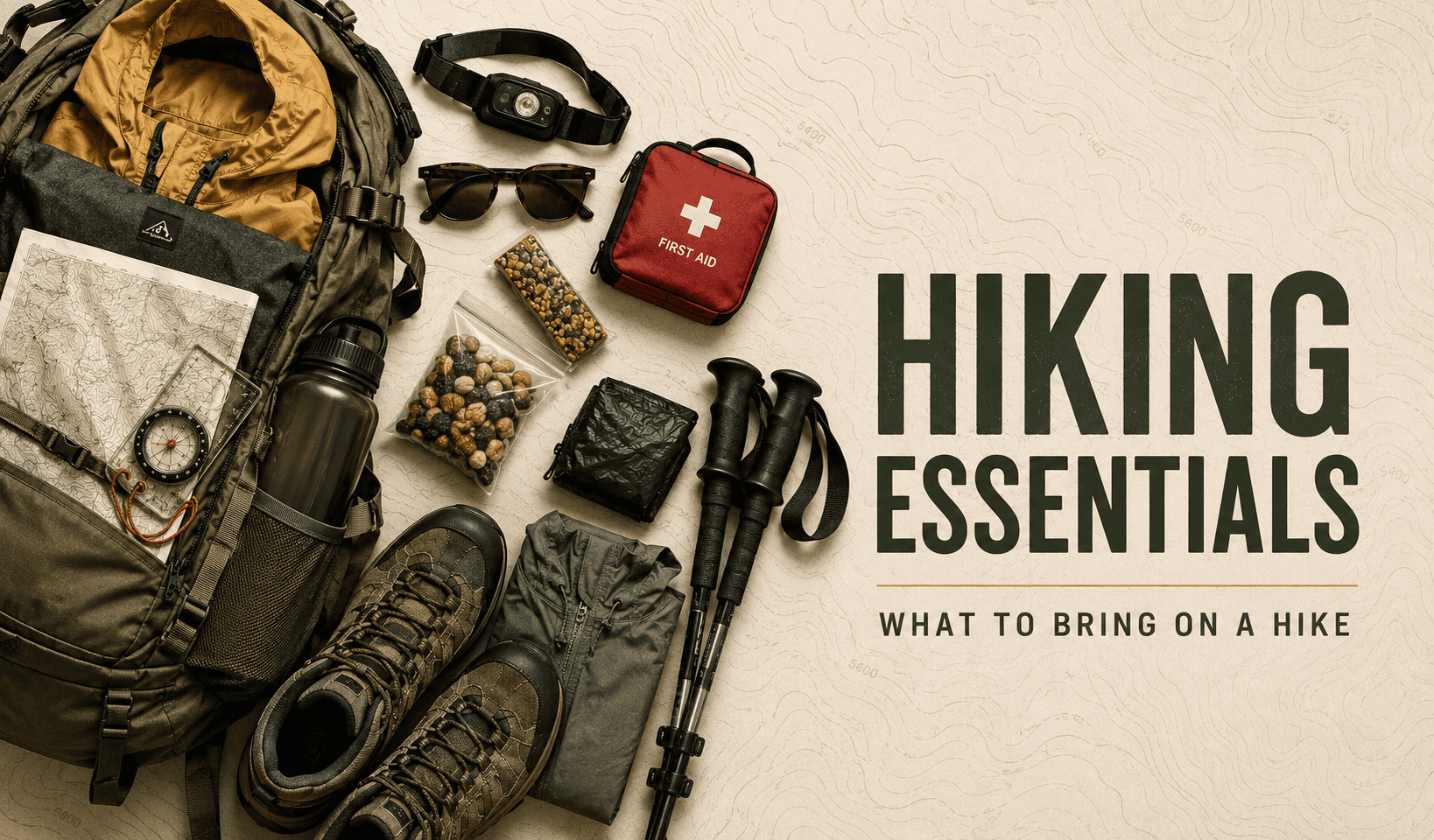
Before the why, here’s the what. This is your baseline for a day hike, scale up for longer or more remote trips, which we’ll get into below.
Navigation
Water & Food
Clothing & Footwear
Safety & First Aid
Sun & Bug Protection
Tools & Extras
The One Nobody Lists
Before You Go
If you’ve spent any time near a trailhead bulletin board, you’ve probably seen some version of this list. It dates back nearly a century, first put together by a Seattle-based climbing club trying to standardize what a prepared hiker should carry into the backcountry. The list has been revised since – modern versions group items into “systems” rather than ten rigid objects but the logic hasn’t changed: assume something will go wrong, and pack accordingly. In their current form, the 10 essentials are usually grouped as:
Not identically, but the categories don’t change, only the amounts. A short, well-marked loop close to your car doesn’t need a bivy sack or three days of food. A remote, all-day route with unreliable cell service does need real navigation backup, more water than you think you’ll drink, and a first-aid kit that goes beyond bandaids.
The rule of thumb that actually holds up: the longer and more remote the hike, and the worse the weather forecast, the more of each category you carry. A local park trail and a wilderness ridge line both need “navigation,” but one of those might just mean “your phone with the trail loaded offline,” and the other genuinely means a compass and the knowledge to use it.
The most important hiking essential isn’t in your pack at all. Checking the weather and trail conditions the morning of – not three days out, when a front can still roll in and change everything takes two minutes and prevents most of the “the trail just disappeared” stories. The second habit matters even more: tell someone your planned route and when you expect to be back. It costs nothing, and it’s the single biggest factor in how quickly help finds you if something actually goes wrong.
This is where most beginner mistakes happen, mine included. Hiking boots give you ankle support and protect against rocky, uneven terrain, which matters most on technical trails. Trail running shoes are lighter and more flexible, better suited to well-maintained paths where you’re moving fast and don’t need the extra structure. What you shouldn’t do is what I did: wear shoes with zero break-in, on terrain you haven’t scouted, and hope for the best.
Look for good lugs [the raised rubber traction bumps on the sole of a hiking shoe] for grip on loose dirt or wet rock, and break any new pair in on short walks before committing them to a real trail.
The standard guidance is about half a liter per hour of moderate hiking in moderate temperatures – more in heat, more at altitude, more if the terrain is steep enough to make you work harder than you planned. For anything beyond a short, familiar loop, it’s worth carrying a way to treat more water if you run low: a lightweight filter or purification tablets [chemical tablets that neutralize bacteria and viruses in untreated water] rather than assuming a stream will be safe to drink straight.
Running dry isn’t just uncomfortable. Dehydration affects judgment before it affects anything else, which is a genuinely bad thing to have happen while you’re deciding which fork in the trail looks more familiar.
Most beginner first-aid kits are built for a paper cut. Trail first-aid kits need to handle blisters, sprains, and small cuts that happen a mile from the car. Moleskin for blister prevention, a few sizes of adhesive bandages, gauze, an elastic wrap for a rolled ankle, and any personal medication you’d genuinely need if you were delayed for hours – that’s the realistic list, not the aspirational one.
Yes, and not because your phone is unreliable exactly, but because it’s unreliable at the worst possible moments. Batteries die faster in cold weather, signal disappears in canyons and dense tree cover, and a cracked screen doesn’t care how good your app is. A paper topographic map [a map that uses contour lines to show elevation changes and terrain shape] and a compass don’t need charging, and knowing how to use both is a skill that transfers to every trail you’ll ever hike, not just the one you downloaded offline.
Nobody turns back from a hike because of sunburn or mosquito bites – they just spend the whole thing miserable and don’t do it again. Sunscreen, a wide-brimmed hat, and sunglasses handle exposure on open ridgelines and above the treeline, where shade disappears. Insect repellent matters more than people expect near water or in humid, wooded terrain, where ticks are a real concern, not just a mosquito-level annoyance.
This is the gap between a casual day hike and the kind of trekking where the trail keeps climbing for days. A few lessons that show up again and again on longer, higher-altitude routes – the same kind covered on multi-day treks like Everest Base Camp or the Annapurna Circuit – but that apply just as well to a tough day hike closer to home:
Trail associations increasingly call this the “eleventh essential,” and it’s the simplest one on this list: a trash bag. Not for gear failure or injury, but for keeping the trails worth hiking in the first place – your own wrappers, and anything less pleasant you’re willing to pick up along the way. A pair of disposable gloves makes that second part a lot less unpleasant.
It doesn’t protect you from anything. It’s just the one item on this list that’s for the trail rather than for you – which might be exactly why it’s the one most lists leave off.
Packing right doesn’t guarantee a perfect hike. Mine certainly wasn’t, blisters and wrong turns included. But it’s the difference between a rough patch you laugh about later and a situation that actually goes sideways, and that’s worth the extra weight in your pack every time.