Physical Address
304 North Cardinal St.
Dorchester Center, MA 02124
Physical Address
304 North Cardinal St.
Dorchester Center, MA 02124

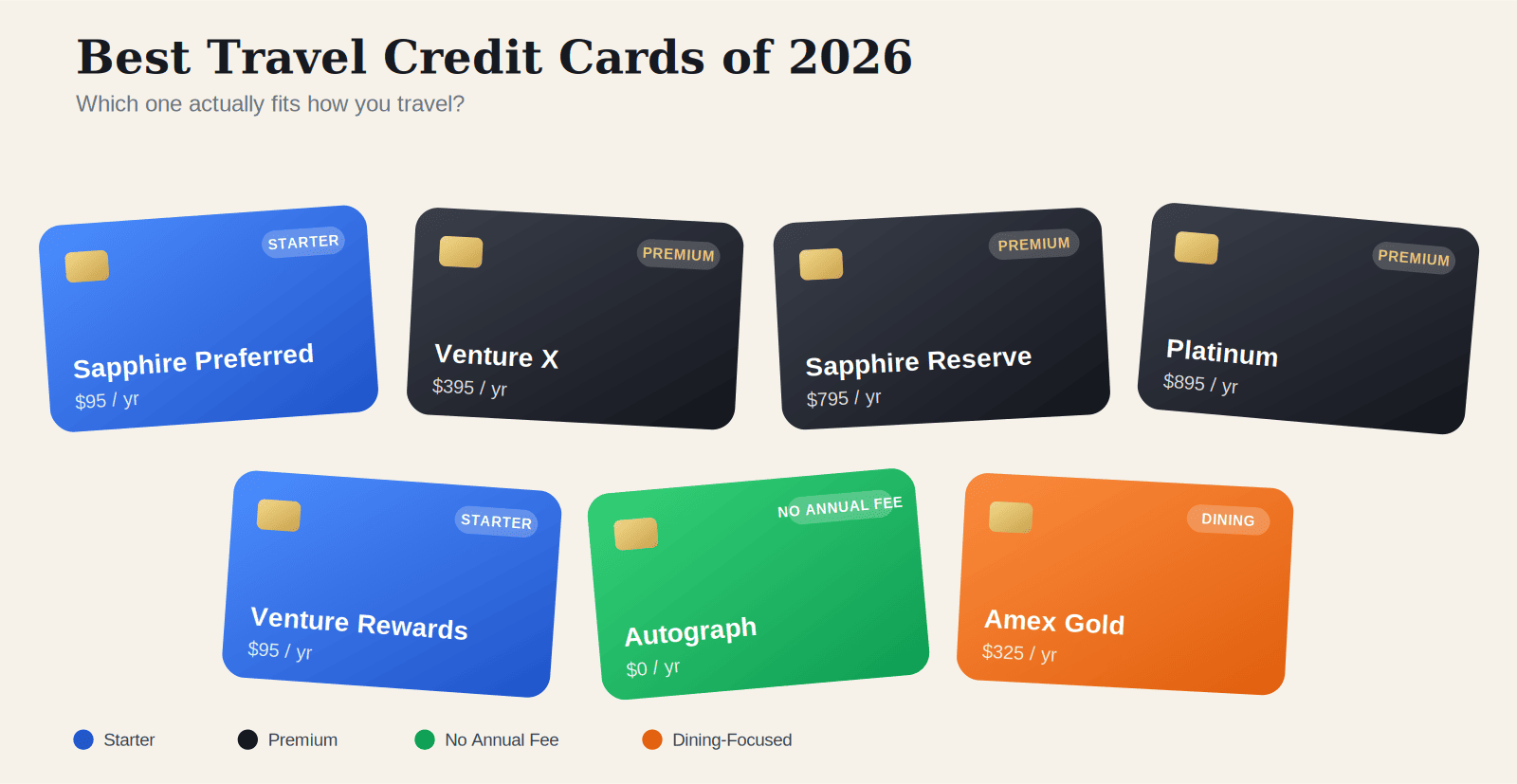
I once stood at a lounge entrance in Frankfurt, watching my boarding time tick down, while an attendant scanned my very shiny, very useless credit card and said, “I’m sorry, this one doesn’t qualify.” Behind me, a man in cargo shorts breezed through with a card that looked exactly like mine. Same bank. Same color. Wrong benefits. I’d spent two years collecting points on a card that was, for lounge access purposes, decorative.
That’s the thing nobody tells you about travel credit cards: they’re not interchangeable. One card’s “premium travel perks” is another card’s fine print. So which one is actually worth carrying in 2026? I put that question to a few people who study this stuff for a living, so you don’t have to learn it the way I did – standing outside a lounge, missing free champagne.
If you’re short on time, here’s the quick version. Each of these earns its spot for a different kind of traveler, the rest of this piece explains why.
| Card | Best for | Annual fee | Standout perk |
|---|---|---|---|
| Chase Sapphire Preferred® | First-time travel-rewards cardholders | $95 | Strong bonus categories, flexible point transfers |
| Capital One Venture X | Premium perks without the four-figure fee | $395 | Airport lounge access, big annual travel credit |
| The Platinum Card® from American Express | Luxury travel and lounge access | $895 (Rates & Fees)* | Broadest lounge network of any card on this list |
| Chase Sapphire Reserve® | Frequent travelers who’ve outgrown the Preferred | $795 | Easy-to-use $300 travel credit |
| Capital One Venture Rewards | Simplicity — flat rewards, no category tracking | $95 | 2x miles on everything |
| Wells Fargo Autograph® Card | Travel rewards with zero annual fee | $0 | Solid rate on travel and dining, no booking-portal lock-in |
| American Express® Gold Card | Travelers who spend more on food than flights | $325 (Rates & Fees)* | 4x on dining and U.S. supermarkets |
Here’s a question worth sitting with before you apply for anything: better for what? A card that’s phenomenal for someone who flies twice a month for work is often mediocre for someone who takes one big trip a year.
The mechanics matter more than the marketing. A card’s real value comes down to a few things: the sign-up bonus, the ongoing rewards rate on categories you actually spend in, whether there’s a foreign transaction fee, and how easy the points are to redeem for something you actually want. A card stacked with perks you’ll never use isn’t a good card, it’s an expensive piece of plastic with a nice welcome bonus. One thing you won’t have to weigh here: every card in this guide waives the foreign transaction fee entirely, so that variable is off the table no matter which one you pick.
If this is your first travel card, start with the Chase Sapphire Preferred® Card. At a $95 annual fee, it’s inexpensive to hold onto even in a year where you barely travel, and its bonus categories are broad enough to rack up points without contorting your spending habits: travel, dining, streaming, online groceries, and EV charging all earn elevated rates. It also comes with no foreign transaction fees and solid built-in travel insurance, the kind of protection you don’t think about until a flight gets cancelled and you’re suddenly grateful for it.
Its main advantage over rival starter cards is redemption flexibility. Points transfer to close to a dozen airline and hotel partners, so you’re not boxed into one airline’s booking site the way some co-branded cards force you to be. Redeemed through Chase’s own travel portal, points are typically worth about 1.25 cents each; transferred to airline or hotel partners, that value can climb higher depending on the redemption.
Chase doesn’t publish an exact credit score cutoff, but approval generally requires good-to-excellent credit, a FICO score of roughly 670 or higher, with stronger odds above 700. Worth knowing before you apply: Chase’s unwritten “5/24 rule” means you’re likely to be denied if you’ve opened five or more new credit cards (from any issuer) in the past 24 months, regardless of your score.
This is where things get expensive, and where a lot of people overspend on a fee they’ll never earn back. Three cards dominate this tier, and they’re not interchangeable either.
The Platinum Card® from American Express, at $895 a year (Rates & Fees), wins on sheer lounge access, more airport lounges than any other card on this list. It’s built for someone who flies enough, and cares enough about the ground experience, that lounge access alone justifies the fee.
Chase Sapphire Reserve®, at $795, argues its case differently: a $300 annual travel credit that applies automatically to almost anything travel-related, flights, hotels, parking garages, even tolls. No enrollment gymnastics required. For travelers who already hold the Preferred, the Reserve is the natural next step once travel spending outgrows the entry-level card.
Then there’s Capital One Venture X, which quietly undercuts both. At $395, it offers lounge access and a $300 travel credit plus a $100 anniversary bonus – meaning the card can pay for more than its own fee before you’ve used a single other perk.
Is a near-$900 annual fee ever rational? Only if you’d pay for those perks anyway. Priced individually, airport lounge memberships, travel credits, and elite hotel status can easily exceed the card’s fee for someone who travels often. For someone who travels twice a year, it rarely does.
All three cards in this tier expect strong credit, but not identically. The Platinum Card generally wants good-to-excellent credit, similar to the Sapphire Preferred. Venture X and the Sapphire Reserve both skew stricter – Venture X in particular tends to require excellent credit, often cited around a 740+ FICO score, since Capital One is notably conservative with this card’s approvals.
Redemption value also splits along program lines, which matters more than people expect. Amex Membership Rewards points redeemed directly (gift cards, statement credits, Amex Travel) typically land around 0.5 to 1 cent per point; the same is true of Capital One miles redeemed directly. Both programs are worth meaningfully more — often 1.5 to 2 cents or higher – when transferred to an airline or hotel partner instead of redeemed at face value, so the “best” card in this tier partly depends on whether you’re willing to do that extra step.
Not everyone wants to memorize bonus categories or track which quarter has 5x on groceries. If that’s you, Capital One Venture Rewards is built for exactly that mindset: a flat 2x miles on every purchase, no exceptions, no rotating categories, no spreadsheet required. The $95 annual fee is modest, and miles redeem broadly – toward travel purchases, through Capital One Travel, or transferred to over a dozen partner programs.
It won’t out-earn a category-optimized card for someone who dines out constantly or books everything through a specific airline. But for the traveler who just wants points to quietly accumulate in the background, “simple” is itself a feature.
Qualification is similarly straightforward: good-to-excellent credit, generally a FICO score around 670 and up, puts this one within reach for most people who’d also qualify for the Sapphire Preferred.
For years, the honest answer was no – free travel cards existed, but they were noticeably weaker than their fee-charging cousins. That’s shifted. The Wells Fargo Autograph® Card charges nothing annually and still pays an elevated rate across categories travel actually runs on – including travel, dining, and gas – without locking your points behind a proprietary booking portal.
It’s not going to get you into a lounge or hand you a four-figure welcome bonus. But if your travel is occasional, or you’re not ready to commit to an annual fee at all, it closes the gap between “free card” and “real travel card” more than most no-fee options have managed.
It’s also one of the more accessible cards on this list from a credit standpoint – good credit is generally enough to qualify, without needing the excellent-credit tier that Venture X or the Reserve expect.
Fair point – plenty of “travel” cards are really rewarding your restaurant habit more than your flights. The American Express® Gold Card leans into that directly: 4x points on dining and 4x at U.S. supermarkets (each up to $50,000 and $25,000 per year respectively, then 1x), alongside a $325 annual fee (Rates & Fees) and a stack of statement credits for dining-related purchases.
If your annual spending on food genuinely outweighs your annual spending on flights and hotels – and for a lot of people, it does – this is arguably the more honest “travel” card, even though it’s not the one that gets you into an airport lounge. It sits in the same good-to-excellent credit tier as the Sapphire Preferred, and its points carry the same redemption math as the Platinum Card above: roughly 0.5 to 1 cent per point direct, more if transferred to a travel partner.
Ignore the marketing copy for a second and ask three questions: How often do you actually travel? Do you already have a favorite airline or hotel chain, or do you want flexibility? And be honest, will you actually use the perks you’re paying for, or will they sit there the way my lounge-access-that-wasn’t did?
Answer those, and the decision mostly makes itself. Occasional traveler who wants simplicity: Venture Rewards or the Autograph card. First travel card, ever: Sapphire Preferred. Frequent flyer who wants the ground experience to match the flight: Venture X, Sapphire Reserve, or Platinum, depending on how much lounge access is worth to you. Bigger grocery and restaurant bill than airfare bill: the Gold Card.
None of them will fix a poorly planned trip. But at least you won’t be the one standing outside a lounge, watching someone in cargo shorts walk in with your exact card and a slightly better set of benefits.
Advertiser disclosure: Some of the cards mentioned above may be from issuers who compensate this site when readers apply through a link on this page. Our comparisons, rankings, and opinions are based on independent research and are not influenced by any advertising relationship. Terms, rates, and rewards are set by the issuer and subject to change.