Physical Address
304 North Cardinal St.
Dorchester Center, MA 02124
Physical Address
304 North Cardinal St.
Dorchester Center, MA 02124

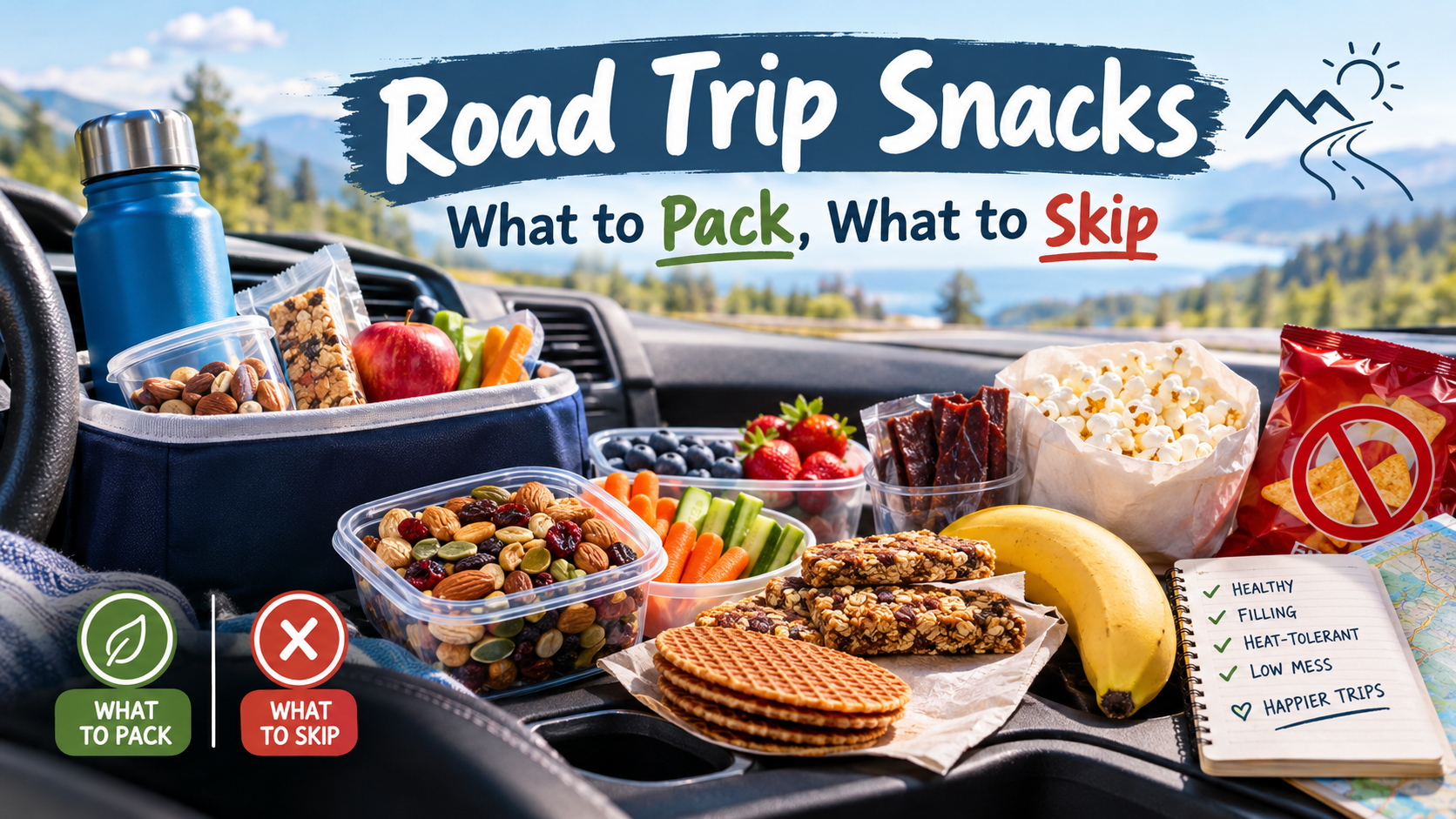
I once bought a family-size bag of chocolate-covered almonds for a July drive, set it in the cup holder, and congratulated myself on my foresight. Four hours later I was prying a warm, almond-studded brick out of the plastic with a car key while my passenger watched in silence. The banana I’d packed as the ‘healthy option’ had achieved a state I can only describe as geological.
So consider me a cautionary tale. Road trip snacks look like the easiest part of any journey, yet the snack bag is where trips quietly go wrong. Somebody gets hangry [a blend of hungry and angry, which is a real thing when blood sugar drops] at hour three, you pull into the first glowing gas station, and forty dollars later you’re back on the road with neon chips and a sugar crash.
Short on time? These are the road trip snacks I’d pack first. The sections after the list explain why, and how to keep them safe.
Sweet
Salty and crunchy
Protein
Fresh
A good road trip snack has to pass a few tests that a good home snack doesn’t. It has to be eaten in a seat with limited elbow room, often by someone whose eyes belong on the road. It has to survive temperature swings, vibration and a stint in a bag at the bottom of the footwell. And it should give you steady energy for hours rather than a sugar spike followed by a slump.
Every snack I pack now has to get through five questions.
Can it be eaten with one hand and no assembly? If it needs peeling, unwrapping with your teeth or a dip, it’s a passenger snack. Is it crumb-light and grease-light? Anything that leaves orange dust on the steering wheel will be remembered. Will it survive a couple of hours in a warm car without turning into something else? Does it carry some protein, fat or fiber, which slow digestion and explain why a handful of nuts holds you longer than a handful of candy? And last, is it a thirst trap?
That last point matters more than people expect. A bag of heavily salted nuts, plus jerky, plus pretzels can add up to a very thirsty, very frequently-stopping car.
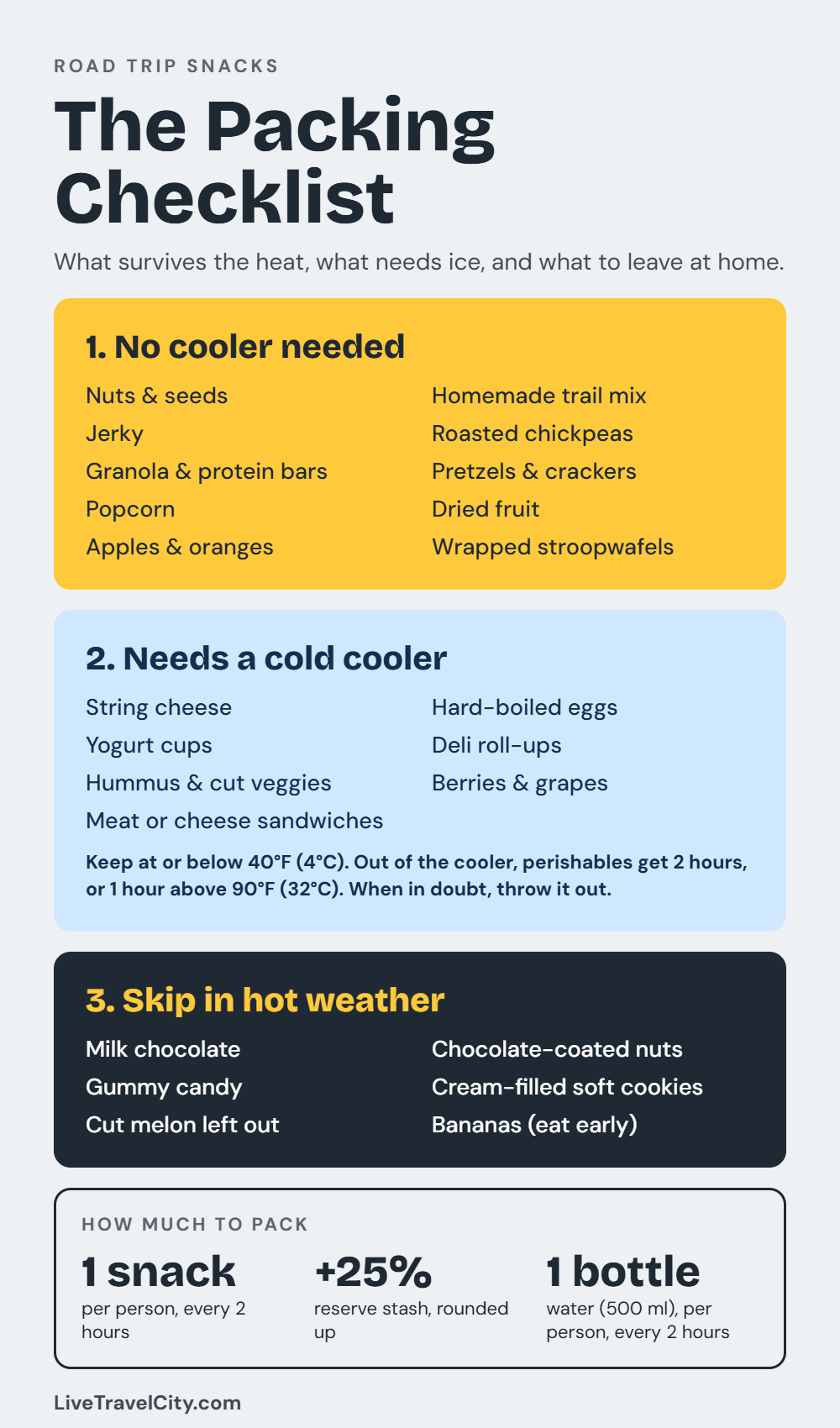
Heat is the great sorter of snacks. Some things shrug it off, some things need a cooler, and a few things should never leave the house in summer.
| Survives the heat (no cooler) | Needs a cooler | Skip in hot weather |
|---|---|---|
| Nuts and seeds, trail mix, jerky, roasted chickpeas, granola and protein bars, pretzels, crackers, popcorn, dried fruit, sturdy fruit (apples, oranges), individually wrapped stroopwafels | String cheese and cheese cubes, hard-boiled eggs, yogurt cups, deli roll-ups, hummus, cut veggies, berries, grapes, sandwiches with meat or cheese | Milk chocolate, chocolate-coated anything, gummy candy (it fuses), soft cookies with cream filling, cut melon left out |
A few notes from the field. Dark chocolate holds its shape better than milk chocolate, though neither is a hero in a parked car, so keep it out of direct sun. Bananas are the exception to the sturdy-fruit rule: they bruise and blacken faster than you’d think, so eat them early in the trip or skip them in summer. And trail mix with chocolate chips is fine in the air-conditioned cabin but turns into a smear on a long summer afternoon, so choose your mix-ins with the weather in mind.
Of all the snack questions, this is the one that can make a road trip miserable. Perishable foods, meaning anything with meat, eggs or dairy, are only safe within certain temperatures. The danger zone [the temperature range, roughly 40°F to 140°F (4°C to 60°C), where bacteria multiply fastest] is exactly where a warm car sits.
The guidance from the U.S. Department of Agriculture’s Food Safety and Inspection Service is that perishable food shouldn’t be left out for more than two hours, and only one hour when it’s hotter than about 90°F (32°C). A cooler packed with enough ice or frozen packs should keep food at or below 40°F (4°C), but only if you treat it properly. USDA even suggests tucking an appliance thermometer into the cooler, so you know rather than guess.
Start by pre-chilling the cooler with ice for an hour, then load cold food straight from the fridge. Freeze a few water bottles to act as ice packs; as they melt, they become drinking water. Keep the cooler in the cabin rather than the trunk, where the air conditioning can help, and drape a blanket over it. Resist rummaging, because every opening lets the cold out, so pack drinks in a separate cooler and keep the food one shut. And when in doubt, throw it out. Is a questionable egg salad sandwich really worth a rest-stop tragedy?
Should the driver’s snack be exciting? Quite the opposite. The point is to keep them fed and alert, not entertained.
The best driver snacks need no unwrapping gymnastics, no crumbs and no looking down. Think shelled pistachios or almonds in a small open container, jerky sticks, dried mango strips, a granola bar already half-unwrapped, or a handful of pretzels. A snack the passenger can hand over, already opened, is even better, and a passenger who acts as snack concierge on long stretches is worth their weight in gas money.
A few ground rules worth following. Don’t fish around in a bag while moving; ask the passenger or pull over. Avoid anything with a dip, a sauce or a peel. Keep a napkin and a wipe within reach, because sticky fingers on a steering wheel are not a fun sensation at 100 km/h. And if you start feeling drowsy, a snack isn’t the cure. Pull over and rest.
Most people get this wrong, packing too much of one snack and too little of everything else.
My rule of thumb, adjusted for appetite and trip length, is roughly one real snack per person for every two hours of driving, plus a small reserve stash for delays, plus about a bottle of water per person every two hours or so. The reserve is the bit that saves you. What happens when a four-hour drive turns into six because of traffic or a missed turn? You’ll be very glad of that extra bag of nuts at the bottom of the cooler.
For a family of four on an eight-hour day, that means around 16 snack portions, four reserve portions, and enough water that nobody has to rely on a service station’s prices. If that sounds like a lot, remember that you’re probably also eating a meal or two on the road. This is just the in-between food that keeps you out of the drive-through.
Here’s the same rule of thumb as a quick reference you can screenshot: one snack portion per person for every two hours of driving, about 25 percent extra as a reserve (rounded up), and one 500 ml (about 16 oz) bottle of water per person every two hours.
| Trip length | Travelers | Snack portions | Reserve portions | Water bottles (500 ml) |
|---|---|---|---|---|
| 4 hours | 2 people | 4 | 1 | 4 |
| 4 hours | Family of 4 | 8 | 2 | 8 |
| 8 hours | 2 people | 8 | 2 | 8 |
| 8 hours | Family of 4 | 16 | 4 | 16 |
| 12 hours | 2 people | 12 | 3 | 12 |
| 12 hours | Family of 4 | 24 | 6 | 24 |
Bump the numbers up for teenagers, hot weather or a trip with few places to stop, and drop them if you’re planning a proper sit-down meal along the way.
There’s no single best snack. There’s the best snack for this drive. Here’s how I’d pack for four common scenarios.
You want slow-burning energy and variety, because by hour six everything tastes the same. Pack roasted chickpeas (crunchy, filling, and they don’t melt), a homemade trail mix with nuts, seeds and a little dark chocolate, jerky or a protein bar for staying power, and apple slices with single-serve nut butter for something fresh. Add one fun thing, such as a sealed pack of stroopwafels or good pretzels, as a morale boost for the afternoon slump.
When you’re only driving a few hours, you don’t need a full cooler. Go simple: popcorn popped at home, clementines (easy to peel, and the smell is oddly cheering), granola bars, and a small bag of cheese and crackers if you can keep it cool.
Think dry, sturdy and sealed. Nuts, seeds, jerky, dried fruit, rice cakes with nut butter packets, roasted seaweed snacks and sturdy fruit like apples will all cope. Freeze a few water bottles and tuck string cheese and hard-boiled eggs next to them in a proper cooler, and eat those first.
Winter is kind to snacks, since a cold car works a bit like a fridge. This is the time for chocolate, soft cookies and muffins, plus a thermos of something hot.
A quick note on salt. Jerky, salted nuts and pretzels are all great, but if you stack all three you’ll spend half the trip looking for a bathroom. Mix in some low-salt options like fruit, unsalted nuts or plain popcorn to keep things balanced.
The healthiest road trip snack is usually one that pairs protein or fiber with something fresh: apple slices with nut butter, hummus with veggie sticks, a hard-boiled egg and a clementine, plain nuts, roasted chickpeas or plain popcorn. Does healthy simply mean low calorie? Not on a long drive, when you want steady energy rather than a tiny snack that leaves you hungry in an hour. Be wary of labels, too. Some granola bars, flavored yogurts and dried fruit mixes carry a lot of added sugar, so check the ingredients list rather than the front of the pack. And pre-portion the trail mix, because it is remarkably easy to eat the whole bag without noticing.
Adults traveling without kids can afford to be a little more grown-up. A small cooler with good cheese, olives, sliced cured meats and whole-grain crackers works like a portable charcuterie board, as long as it stays properly cold. Add spiced or roasted nuts, dark chocolate, crisp apples or pears, and a thermos of coffee or tea, plus sparkling water in a cold bottle for when plain water gets dull. If you’re driving, keep portions modest: heavy, greasy food and big hits of sugar can leave you drowsy or jittery.
Three homemade snacks cover a good chunk of the list above, and none of them needs a recipe card. Treat the proportions as starting points and adjust to taste.
Trail mix, the 2-1-1 way. Mix two parts nuts (almonds, cashews or peanuts), one part dried fruit (cranberries, apricots or mango) and one part seeds or pretzel pieces. Add a small handful of dark chocolate chips only when the weather is cool. Portion it into zip bags before you leave so nobody eats the whole batch by hour two.
Roasted chickpeas. Drain and rinse a can, then dry the chickpeas thoroughly, because moisture is the enemy of crunch. Toss with a tablespoon or so of olive oil, salt and a spice you like (smoked paprika and chili-lime both work), and spread them on a baking tray. Roast at about 200°C (400°F) for 25 to 30 minutes, shaking the tray halfway, until crisp. Let them cool completely before sealing them in a bag, or they go soft.
No-bake energy bites. Stir together about a cup of rolled oats, half a cup of nut butter and a third of a cup of honey, plus a handful of add-ins such as chocolate chips, seeds or dried fruit. Roll into balls and chill for a few hours. Use seed butter if you need a nut-free version, and keep them cool in summer.
Kids on a road trip are a unique species: bored, hungry and capable of dropping a squashed raisin in an impossible place. The best snacks for them are individually portioned, easy to eat with little hands and not too sticky. Snack boxes with compartments (a bento box or a tackle box works nicely) let them choose what they eat without rummaging through a bag. Hungry is only half the problem. For the bored half, see our road trip activities guide.
One serious point. Some common road trip foods are choking hazards for young children. The American Academy of Pediatrics advises keeping foods such as nuts and seeds, whole grapes and popcorn away from children until age four or older, and chopping round, firm foods like grapes and hot dogs into tiny pieces. Chunks of cheese or meat appear on many pediatric lists too, so cut them into small strips. Several safety guides also advise against letting young children eat while the car is moving, since a sudden stop makes choking more likely. For the littlest passengers, that means planning snack stops rather than snacking at highway speed.
For kids who can safely manage them, good bets include cheese sticks, crackers, banana slices, applesauce pouches, mini muffins and yogurt tubes (kept cool). Pack a few wet wipes, a trash bag within reach, and one ‘special treat’ that only comes out after a long stretch without complaining. Bribery, for the record, is a legitimate road trip strategy.
Most snack lists lean heavily on nuts, which is a problem if anyone in the car has a nut allergy. A closed car is a small space, and residue on hands, seats and seat belts can linger. If someone has a serious allergy, the safest move is usually to keep the whole car nut-free and read every label, because cross-contact [when traces of an allergen transfer from one food or surface to another] can happen even in products that don’t list nuts as an ingredient. If anyone carries a prescribed epinephrine auto-injector, it should stay in the cabin with them, not in a hot trunk.
Fortunately, there are plenty of tasty alternatives. Sunflower and pumpkin seeds, roasted chickpeas, rice cakes, popcorn, fresh fruit, seaweed snacks and coconut chips are often naturally free of the major allergens, though you should always check labels for cross-contact warnings. For gluten-free travelers, look for certified gluten-free pretzels and bars. For vegans, hummus with veggie sticks, dried fruit, nut-free trail mix and fruit leather all travel well.
Is homemade really cheaper than the gas station? It’s easy to claim and harder to prove, so here’s an invitation rather than a number: next time you stop, check what a single-serve bag of nuts or a bottle of water costs at the pump, then compare it with the per-portion price of the same thing from a big grocery pack at home. Whatever the gap turns out to be, it adds up quickly across a family and a multi-day trip.
The cheapest road trip snacks tend to be pantry staples that you portion yourself: popcorn kernels popped at home, oats and nut butter for energy bites, bananas and apples, carrots, big bags of nuts and seeds, and a block of cheese cut into pieces. Buy the large bag, divide it into zip bags, and the cost per snack drops quickly.
Watching the whole budget, not just the snack bill? Our guide on how to save money on a road trip goes well beyond the snack aisle.
It happens. You forgot the cooler, the trip ran long, or you simply wanted a stretch. The good news is that you can still do reasonably well if you shop with a plan.
Head for the nuts and seeds shelf (go for the plain or lightly salted), jerky (check the sodium), bananas or apples if there’s a basket by the register, plain popcorn, string cheese from the cooler, and water. Walk past the neon chips, the giant sodas and anything labeled ‘rocket fuel.’ Your afternoon self will thank you.
Packing is a quiet art. A little structure turns a chaotic snack bag into something that works for everyone.
Portion everything before you leave. Zip bags and small containers mean nobody passes a family-size bag around the car; bags can be tossed, while containers need washing, so choose based on how much cleanup you want later. A clear bin or bento-style box lets everyone see what’s on offer without digging, and keeping it within reach of the front passenger makes them the official distributor. Carry a dedicated trash bag, with napkins and wet wipes in the glove compartment. Put squishy, breakable things like muffins and soft fruit on top and the sturdy ones at the bottom. And eat the perishables first: the cheese, eggs and berries go at the top of the cooler and get finished early in the trip.
If you want a truly low-effort version, pre-pack one small bag per person with a mix of sweet, salty and something fresh. Label them if you like. It reduces arguments, and it makes the end-of-day cleanup far easier.
What are the best road trip snacks? The best ones are easy to eat, low in mess and heat-tolerant, with enough protein, fat or fiber to keep you full. Nuts, jerky, roasted chickpeas, apples, popcorn and homemade trail mix are reliable all-rounders.
What snacks don’t melt in a hot car? Nuts, seeds, jerky, dried fruit, pretzels, crackers, granola bars and popcorn are all safe bets. Avoid milk chocolate, chocolate-coated snacks and gummy candy in hot weather.
What can a driver eat with one hand? Snacks that need no unwrapping or peeling, such as shelled nuts in an open container, jerky sticks or dried mango strips. Ideally the passenger opens and hands them over.
How much food should you pack for a road trip? A good rule of thumb is about one snack portion per person for every two hours of driving, plus a small reserve stash and enough water for the whole trip.
How do you keep food cold without a cooler? A cooler is far better, but frozen water bottles wrapped in a towel inside an insulated bag can work for a few hours. For anything perishable on a longer drive, use a proper cooler.
What are good healthy road trip snacks? Fresh fruit, nuts, seeds, roasted chickpeas, veggie sticks with hummus, hard-boiled eggs (kept cold), cheese sticks and homemade granola bars, ideally with a mix of protein, fat and fiber.
These days my road trip bag is a lot less ambitious than it used to be. A small cooler with frozen water bottles, cheese sticks and a couple of eggs. A zip bag of homemade trail mix with exactly one square of dark chocolate in it, and I check the weather before I decide even that. Apples, a bag of popcorn, a packet of jerky, and a roll of napkins I’ll definitely need.
It isn’t glamorous, and nobody will photograph it. But the car stays calm, the stops stay short, and the almond brick is a distant memory. And if I do end up at a pump, I walk straight past the neon chips.
Still planning the rest of the drive? Our guide to the best road trip apps can help with the route and the stops.