Physical Address
304 North Cardinal St.
Dorchester Center, MA 02124
Physical Address
304 North Cardinal St.
Dorchester Center, MA 02124

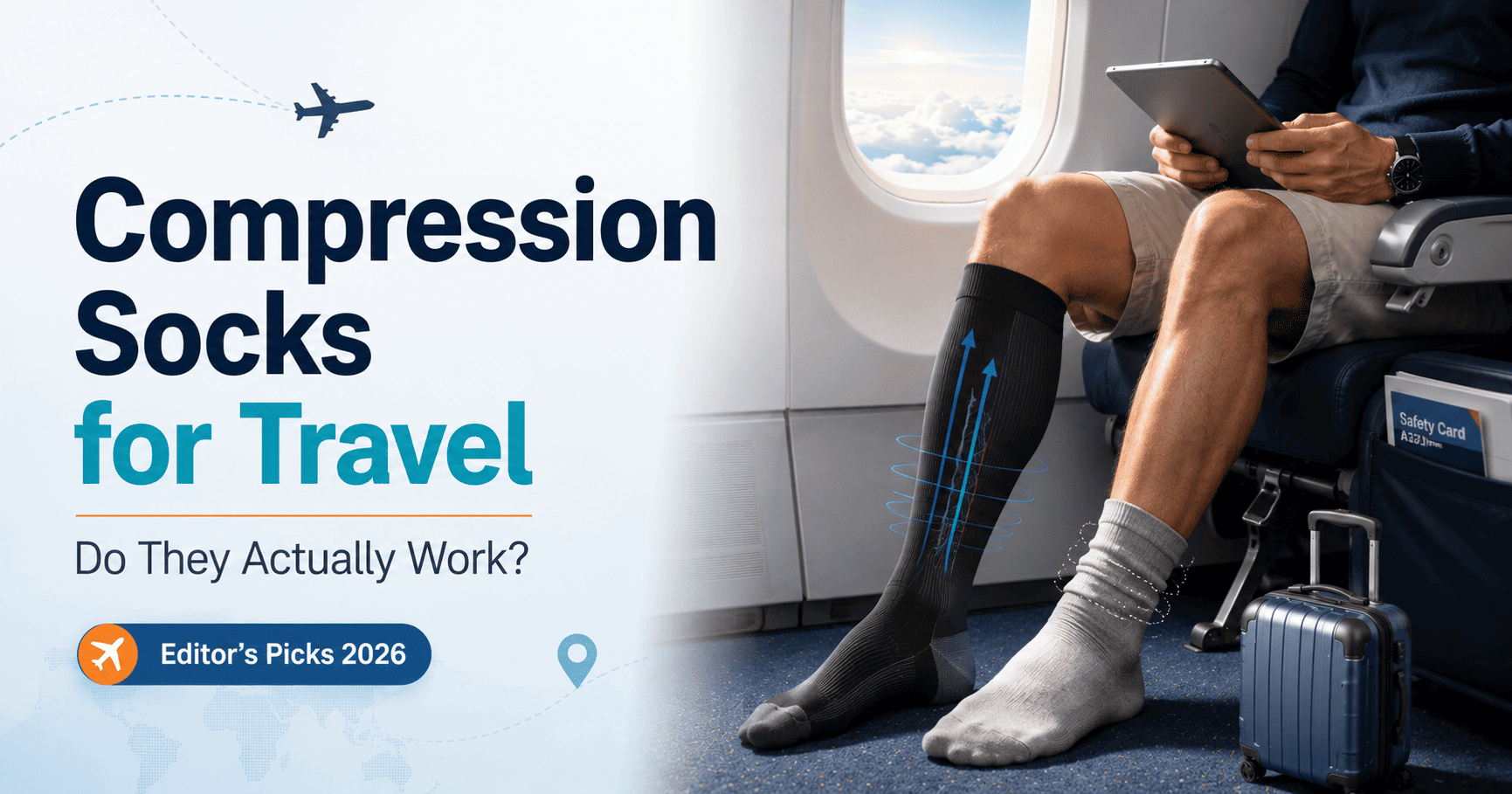
My first pair of compression socks arrived two days before a fourteen-hour flight, and getting them on felt like wrestling a stubborn sausage casing onto each leg. I landed with my ankles still looking like ankles instead of the swollen stumps I usually disembark with, and I’ve been quietly suspicious of myself (was that real, or placebo?) ever since.
So which ones are actually worth the wrestling match, and do they even do what they claim? Let’s start with what’s worth buying, then get into the evidence.
The shelf (or the search results page) is dizzying, so here’s the quick version first, five real options rather than forty near-identical Amazon listings:
| Category | Best Option | Key Benefit | Best For |
|---|---|---|---|
| Best All-Rounder | Trtl Bamboo ($29.99, 15-21 mmHg) | Cool, breathable bamboo-viscose blend | General long-haul travelers |
| Best Low-Profile | Wellow (18-25 mmHg) | Looks like an ordinary sock | Style-conscious travelers |
| Best Wide Calf | Levsox (15-20 or 20-30 mmHg) | Built specifically for larger calves | Travelers needing a wider fit |
| Best Medical-Grade / Long-Haul | CEP Flight ($55, 20-30 mmHg) | True medical-grade compression | 8+ hour flights or higher clot risk |
| Best Temperature-Regulating | Bombas (15-20 or 20-30 mmHg, merino wool blend) | Adapts to cabin temperature swings | Travelers prone to hot or cold feet |
Here’s more on why each one made the cut:
One thing worth knowing before you buy anything: the mmHg number matters less than getting the length and calf fit right for your actual leg. A well-fitted 15 to 20 mmHg sock beats a badly-fitted 20 to 30 mmHg one every time, for reasons that’ll make more sense in a minute.
Here’s the scary reason compression socks exist in the first place: deep vein thrombosis [DVT, a blood clot that forms in a deep vein, usually in the leg, and can become life-threatening if it travels to the lungs]. Sitting still for hours slows blood flow, and cabin conditions (low humidity, low pressure, zero legroom) don’t help. WebMD puts the risk at roughly three times higher while flying than otherwise, though that’s tripling an already-low baseline.
A Cochrane review pooling data from nearly 3,000 passengers on flights of five hours or more found something interesting: nobody in either group, compression or no compression, developed a DVT with symptoms. But on follow-up scans checking for symptomless clots, the compression group had far fewer, roughly two or three per thousand versus the tens-per-thousand range without.
So the honest takeaway: compression socks aren’t a dramatic life-saving shield, but they do measurably cut an already-low risk, plus leave your legs noticeably less swollen by the time you land. Worth the wrestling match? I’d say yes, just don’t mistake it for a guarantee against everything that could go wrong on a flight.
That mmHg number stamped on the packaging is millimeters of mercury [the same pressure unit used to measure blood pressure], and it tells you how firmly the sock squeezes your leg. Higher number, tighter squeeze. Most guidance from vascular specialists and sock manufacturers alike breaks down roughly like this:
A detail that trips people up: these should be graduated compression socks, meaning the pressure is tightest at your ankle and gradually eases moving up your calf. That gradient is what actually pushes blood upward toward your heart. A sock that squeezes evenly, or worse, tighter at the top, isn’t doing the job no matter what number is printed on the label.
Here’s an uncomfortable truth most product pages don’t lead with: a well-fitted moderate sock does more for you than an ill-fitting firm one. Sizing, not strength, is where most people go wrong.
Knee-high socks are generally recommended over ankle or thigh-high versions for travel, since they cover the calf muscles where most of the pooling happens without the extra fuss (and extra tightening behind the knee) that thigh-highs can cause. Most brands ask you to measure your calf circumference at its widest point and match it against a sizing chart, which feels tedious until you realize it’s the difference between socks that work and socks that just look tight.
Signs your fit is right:
If you’re getting the opposite of any of that (bulging above the sock, throbbing, a line dug into your skin), size up before deciding compression socks just aren’t for you.
This one surprised me: timing matters almost as much as sizing. The swelling compression socks are meant to prevent starts the moment you sit down and stay still, not sometime later in the flight. Putting them on 30 to 60 minutes before boarding, while you’re still mobile in the terminal, gives your circulation a head start instead of playing catch-up once you’re already wedged into a middle seat.
On the other end, most guidance suggests taking them off before sleeping for the night, as opposed to a daytime nap mid-flight, unless a doctor has specifically told you otherwise. Compression socks are designed for periods of sitting or standing, not for twelve hours of continuous overnight wear.
This is the part most product pages bury at the bottom, if they mention it at all, and it matters more than any sizing chart.
Compression socks work by squeezing your veins to help blood move upward. If your problem is actually in your arteries rather than your veins, as with peripheral artery disease, adding external pressure can make things worse rather than better, since it further restricts blood flow those arteries are already struggling to deliver. The same caution applies if you have significant nerve damage or numbness in your legs, certain heart conditions, or open wounds or skin infections on your legs.
None of this is meant to talk you out of compression socks. For the vast majority of healthy travelers, they’re genuinely low-risk and reasonably effective. But if you have an existing circulation, heart, or nerve condition, this is a “check with your doctor first” situation, not a “grab whatever’s on sale at the airport” one.
If your travel involves more than the flight itself, this is worth knowing: the long jeep ride to a trailhead can rival the flight for pure immobility. Trekkers heading to Everest Base Camp or the Annapurna Circuit often underestimate the hours-long, bumpy overland transfer to the trailhead as much as the flight that got them to Kathmandu in the first place. If your itinerary stacks a long-haul flight directly onto a long overland transfer, that combined stretch is arguably where compression socks are earning their keep the hardest, not the trek itself.
Once you’re actually walking, you can mostly retire them. Hours of daily hiking is about as good as circulation support gets, no mmHg rating required. The socks matter most in the sitting, not the climbing.
I still don’t love putting mine on. It’s still a small, undignified wrestle every time, usually accompanied by a passenger in the next seat pretending not to watch. But somewhere between the Cochrane data and my own suspiciously normal-looking ankles after every long flight since, I’ve stopped thinking of it as a placebo. It’s a small, well-evidenced habit for the parts of travel where your body is doing the least and asking for the most. Buy a pair in the right category for your trip, size them properly, and put them on before you sit down rather than after your legs have already started arguing with you.