Physical Address
304 North Cardinal St.
Dorchester Center, MA 02124
Physical Address
304 North Cardinal St.
Dorchester Center, MA 02124

Sizes and limits checked October 2026
I once stood at a departure gate in a fleece, two T-shirts and a scarf, sweating through all of it, because my “carry-on” suitcase would not fit into the metal frame beside the desk. The bag had the word carry-on printed right on its tag. It had been a carry-on in every airport I’d ever used it in, right up until that morning. The agent was kind about it, which was almost worse. He waited patiently while I knelt on the carpet and redistributed a week of clothes into my pockets.
Here is what nobody tells you when you buy that bag: “carry-on” is a marketing word, not a measurement. Airlines write the rules, and when you cross a border, the rules change with you.
This guide gives you the numbers that matter: one safe size that works almost everywhere, a size and weight chart for major international airlines, what budget carriers like Ryanair and easyJet actually allow now, and what changes on domestic flights in Nepal, where the cabin bag you’ve been dragging around the world may be completely useless.
Quick answer: the safest international carry-on size is 55 x 35 x 20 cm (21.7 x 13.8 x 7.9 inches), including wheels and handles, packed to under 7 kg. That fits nearly every full-service airline. Always confirm your own carrier’s limits before you fly.
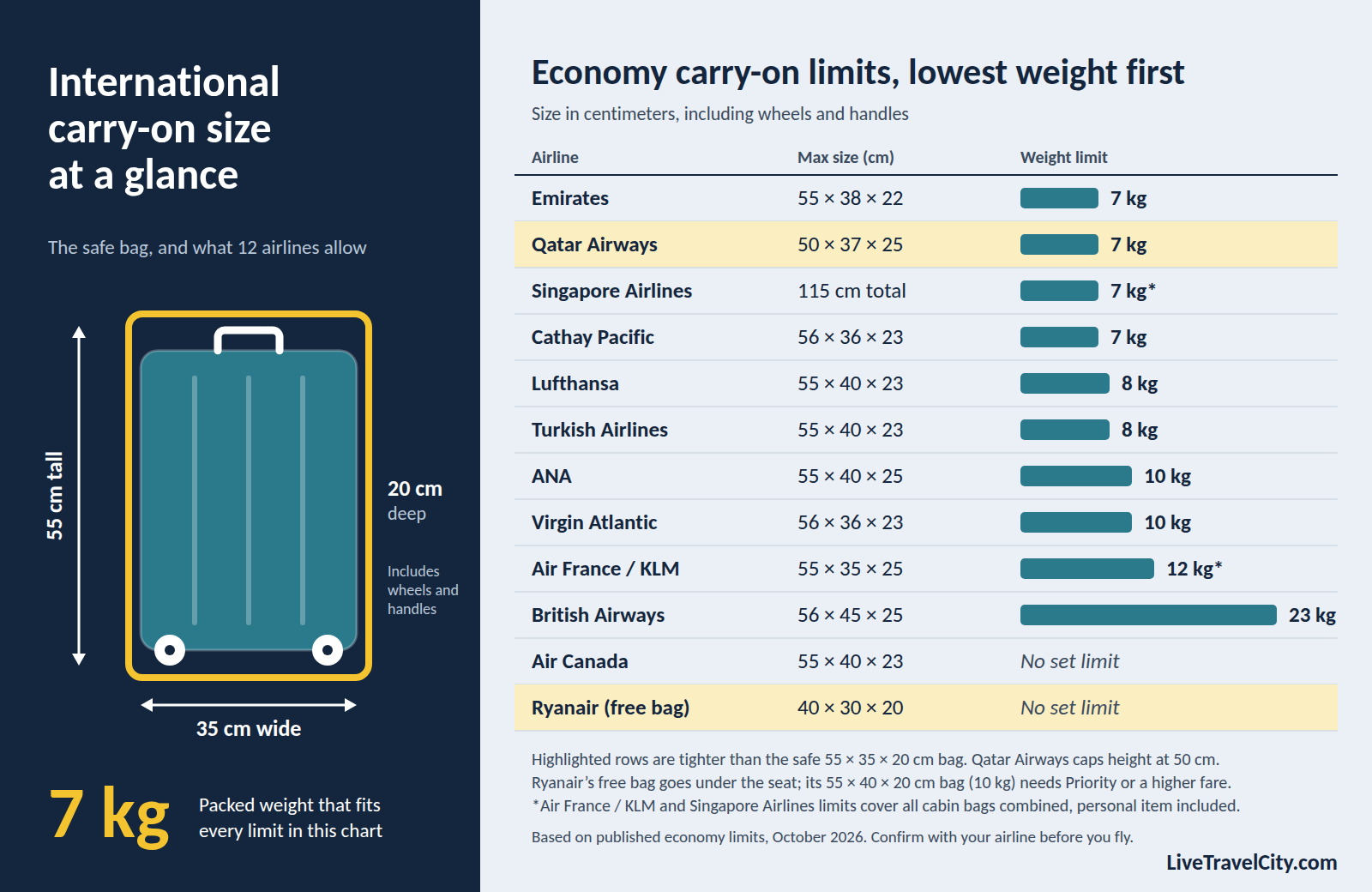
Aim for 55 x 35 x 20 cm (about 21.7 x 13.8 x 7.9 inches), measured with wheels and handles included. That’s exactly the size IATA [the International Air Transport Association, the airline industry’s trade body] floated in 2015 under a voluntary guideline called Cabin OK (it later paused the rollout after pushback, mainly in North America), and it slips inside the published economy limits of nearly every full-service airline in the chart below. The one notable exception is Qatar Airways, which caps height at 50 cm.
You’ll often see 55 x 40 x 20 cm quoted as “the international standard.” It works on plenty of carriers, but Air France and KLM cap width at 35 cm, so a 40 cm-wide bag is a gamble on those routes.
What about the bag most people already own, the US standard of 22 x 14 x 9 inches (56 x 36 x 23 cm)? It clears many airlines abroad. But it sits a centimeter taller than the 55 cm limit on Lufthansa, Emirates, Air France and several others, and a centimeter is exactly how gate agents like to ruin your morning.
Mostly it isn’t physics. It’s policy and enforcement. Most US airlines cluster around the same 22 x 14 x 9 inch limit and rarely put a bag on a scale. Plenty of airlines in Europe and Asia do both, and they’re far more likely to check.
Even American carriers bend on international routes. Delta, for example, limits carry-ons to 22 pounds on flights to and from Beijing and Shanghai, and to 15 pounds on Singapore routes, according to The Points Guy.
Fare type matters too. Many international airlines decide whether you get one cabin bag or two, and how heavy they can be, based on the ticket you bought. The cheapest fare is rarely the generous one. Air Canada, KLM and Air France all sell basic fares that leave out the standard cabin bag on some routes, so check what your ticket actually includes.
These are published economy-class limits. Airlines revise them, and rules can vary by route, aircraft and fare, so confirm on your airline’s website before you pack.
| Airline | Max size (cm) | Max size (inches) | Note |
|---|---|---|---|
| Air Canada | 55 x 40 x 23 | 21.5 x 15.5 x 9 | No specific weight limit |
| British Airways | 56 x 45 x 25 | 22 x 18 x 10 | Most generous of the group |
| Lufthansa | 55 x 40 x 23 | 21.7 x 15.7 x 9 | |
| Air France / KLM | 55 x 35 x 25 | 21.7 x 13.8 x 9.9 | Narrow width limit |
| Emirates | 55 x 38 x 22 | 21.7 x 15 x 8.7 | |
| Qatar Airways | 50 x 37 x 25 | 20 x 15 x 10 | Shortest height limit here |
| Turkish Airlines | 55 x 40 x 23 | 21.7 x 15.7 x 9 | |
| ANA | 55 x 40 x 25 | 21.7 x 15.7 x 10 | |
| Virgin Atlantic | 56 x 36 x 23 | 22 x 14 x 9 | |
| Cathay Pacific | 56 x 36 x 23 | 22 x 14 x 9 | |
| Singapore Airlines | 115 cm total | 45 in total | Length + width + height combined |
| Korean Air / Japan Airlines | 115 cm total | 45 in total | Combined dimensions |
| Air New Zealand | 118 cm total | 46.5 in total | Combined dimensions |
See the totals-only airlines in that last group? Those add height, width and depth together [known as linear inches or linear centimeters] instead of capping each side. It’s more forgiving for oddly shaped bags, but it’s also an easy way to miscount at home.
This is where travelers get caught. Ever watched a gate agent heft a bag, frown, and reach for the scale? A bag can pass the sizer, glide past the check-in desk, and still be turned back at the gate because the scale disagrees.
| Airline | Economy carry-on weight limit |
|---|---|
| Emirates, Qatar, Singapore Airlines, Cathay Pacific, Air New Zealand | 7 kg (15 lb) |
| Lufthansa, Turkish Airlines | 8 kg (17.6 lb) |
| Virgin Atlantic, ANA, Korean Air, Japan Airlines | 10 kg (22 lb) |
| Air France / KLM | 12 kg (26 lb), carry-on and personal item combined |
| British Airways | Up to 23 kg (51 lb), and you must be able to lift it overhead yourself |
| Air Canada | No specific limit, but it must be liftable |
Figures differ slightly between sources, and some airlines count your personal item toward the same total, so treat this as a planning guide, not a promise.
The practical lesson: a hard-shell suitcase can weigh two to four kilograms empty. On a 7 kg limit, that leaves you with almost nothing for clothes. Weight, not size, is usually what forces people to check a bag. So why does nobody mention that when you buy the suitcase?
Budget carriers are a different game, and the rules have changed recently enough that plenty of articles online are out of date.
Ryanair now includes one small bag of 40 x 30 x 20 cm for every passenger, which must fit under the seat. The airline raised it from 40 x 25 x 20 cm in 2025, following EU moves toward a 40 x 30 x 15 cm minimum for free under-seat bags. A larger cabin bag of 55 x 40 x 20 cm and up to 10 kg comes with Priority boarding or certain fares. Anything else goes in the hold for a fee, and gate staff do check.
EasyJet’s free under-seat bag is 45 x 36 x 20 cm. A larger cabin bag of 56 x 45 x 25 cm (up to 15 kg) is available, depending on the fare you choose.
If you see 40 x 25 x 20 cm quoted as Ryanair’s free allowance, that’s the old number.
On most full-service airlines, yes: one cabin bag plus a small personal item such as a handbag, laptop bag or small backpack. But the exceptions are exactly where people get stung.
Many European budget airlines allow only one small bag on the cheapest fares. Some carriers count the combined weight of everything you bring into the cabin, not each bag separately. Singapore Airlines and Air France/KLM work this way, according to published policies. If the combined limit is 7 kg, your laptop bag is part of that weight.
Where airlines publish personal-item sizes, the limits are small. On US carriers, United allows 17 x 10 x 9 inches, American 18 x 14 x 8 and JetBlue 17 x 13 x 8. In Europe, Ryanair’s free bag is 40 x 30 x 20 cm and easyJet’s is 45 x 36 x 20 cm. Many airlines abroad simply say the bag must fit under the seat in front of you, so a bag around 40 x 30 x 15 cm is a safe target almost anywhere.
The strictest one. If your long-haul flight is on a generous airline and your connecting flight is a regional hop with a tight cabin limit, the smaller limit sets the rule for the whole trip. Gate agents on the second flight won’t care what happened on the first.
On multi-airline itineraries, pack to the strictest carrier’s size and weight, and give yourself a small buffer for the return journey, when souvenirs have a way of adding two kilograms you didn’t plan for.
Still booking? Our guide to the best time to buy plane tickets shows when fares tend to be lowest.
Here’s where the bag you carried across the world can stop making sense. Nepal’s domestic airlines fly small turboprops (propeller aircraft with limited overhead space), and their allowances are built around weight rather than a sizer.
On standard routes such as Kathmandu to Pokhara, domestic carriers generally allow around 20 kg checked baggage and 5 kg of hand carry. On mountain sectors such as Lukla and Jomsom, the checked limit drops to about 10 kg, again with 5 kg of hand carry. Some airlines and trek operators describe the Lukla allowance as 15 kg in total, so ask which version applies to your ticket.
That’s why trekkers rarely arrive at the Lukla check-in with a wheeled suitcase. A soft duffel and a small daypack are far easier to weigh and load. Many hotels in Kathmandu will store the rest of your luggage while you’re on the trail. For route planning and what to pack, see our trekking in Nepal guide and Everest Base Camp trek guide.
Airline baggage rules in Nepal change, and excess baggage is typically charged per kilogram, so confirm the current allowance with your airline or trek operator before you fly.
Airline sizers [the metal or plastic frames at gates and check-in desks] measure the outside of your bag. That includes wheels, handles and any pockets, so the number on the manufacturer’s tag often understates the real size.
Then weigh it packed, at home, on a bathroom scale. Step on the scale holding the bag, step on again without it, subtract the two, and leave a kilogram of margin.
Most of the damage comes from a short list of avoidable errors:
Not always. The US standard of 22 x 14 x 9 inches is common on domestic flights, while international airlines are often a little tighter on size and noticeably stricter on weight.
Yes. Airlines measure the whole bag, including wheels and handles.
Yes, as long as it meets the airline’s size and weight limits. A soft-sided backpack tends to squeeze into a sizer more easily than a rigid suitcase of the same dimensions.
If you’re shopping for a new bag, start with our guide on how to choose a travel backpack.
You’ll usually be asked to check it at the gate and may pay a fee. On budget airlines, that fee can cost more than the ticket did.
They’re separate from size rules, but the common standard is containers of 100 ml (3.4 oz) or less, packed in a single clear bag. Rules vary by airport, so check before you fly.
Pack to the stricter side. Measure the bag you actually own, including wheels and handles. Weigh it before you leave home. And if you fly several airlines on one trip, let the strictest one set your limits.
Do that, and you’ll never find yourself kneeling on an airport carpet in three layers of clothing, as I once did. Airlines revise their policies regularly, so check your carrier’s website a few days before departure.