Physical Address
304 North Cardinal St.
Dorchester Center, MA 02124
Physical Address
304 North Cardinal St.
Dorchester Center, MA 02124

My family’s last cross-country road trip started with a “we’ll figure out gas along the way” attitude and ended with me feeding twenty-dollar bills into a pump at the only station for sixty miles. We hadn’t planned a single fill-up. Not one.
It was an expensive lesson, and the tuition has gone up. As of September 18, the AAA national average for a gallon of regular is about $4.47. In early January it was $2.81. An epic road trip and a blown budget don’t have to go together, but only if you plan for it before you’re stuck paying rest-stop prices.
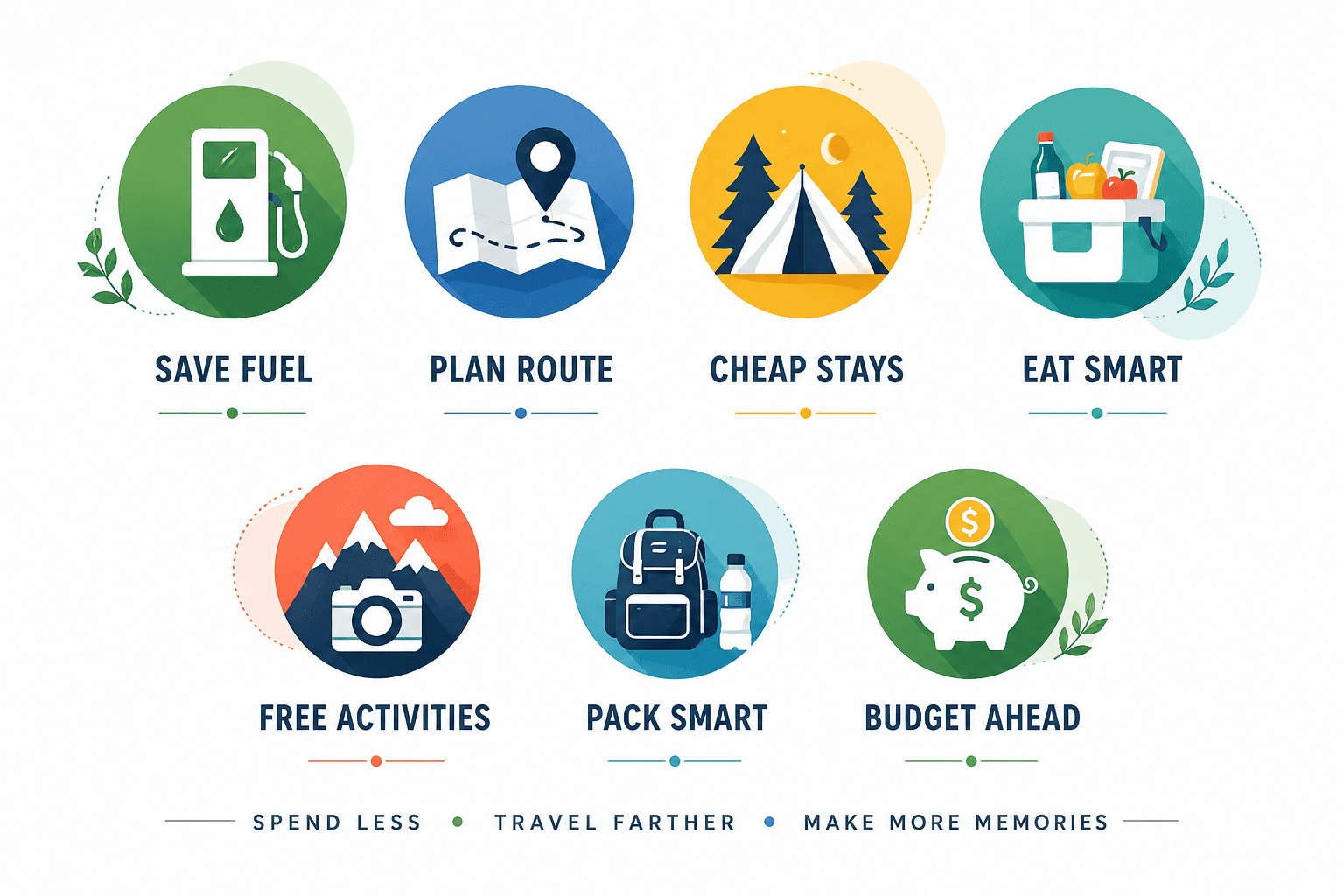
So here are 48 ways to save money on a road trip, from cutting gas costs to eating well without eating into your budget. Where I could put a number on a tip, you’ll see a “what it’s worth” line.
Road trip costs sneak up on you in a way plane tickets don’t. There’s no single sticker-shock moment, just gas, food, and lodging quietly adding up over a thousand miles. The cure is to turn that vague dread into a number.
What it’s worth: about $89 of surprise avoided. The same 1,500-mile drive costs roughly $239 at today’s price and would have cost about $151 in early January.
Fuel is the one cost you can calculate instead of guess: divide your trip miles by your real-world miles per gallon, then multiply by the price per gallon. A 1,500-mile trip at 28 mpg burns about 54 gallons. The AAA gas cost calculator and the Department of Energy’s tools at fueleconomy.gov will do the arithmetic for your own car. Estimate costs in advance, before you’re standing at the pump.
Breaking your budget down to a cost per day, so fuel and lodging can be planned along the actual route. A daily number is easier to defend at a lunch counter than a trip total. It’s much harder to talk yourself into a $30 roadside lunch when you know exactly what today’s number is. If you’re planning a special dinner or an expensive attraction on day three, set a bigger number for that day and a smaller one for the days around it.
Budget guides commonly suggest padding the total by 10 to 15 percent. The tire that goes flat on day three doesn’t care about your spreadsheet. If the buffer goes unused, congratulations: you just funded the next trip.
Two people splitting one hotel room and one tank each pay roughly half of both, which is where the old “cut costs in half” advice comes from. In a fuller car the split gets better, but meals, tickets, and snacks multiply too. Bigger group affects lodging, meals, fuel consumption, and attraction fees, some of it in your favor and some against. Agree on how you’ll split before you leave, not at the pump.
A roadside breakdown costs far more than the inspection would have. Oil, tire pressure, and clogged air filters are the usual suspects, and fixing them helps fuel economy too. The Department of Energy says an out-of-tune engine costs about 4 percent in efficiency on average, and the wrong grade of motor oil can cost 1 to 2 percent.
If your everyday car is a gas guzzler, think about renting something more efficient. What it’s worth: about $180 in fuel. Over 1,500 miles at today’s price, a car that gets 18 mpg burns about $372 of gas, while one that gets 35 mpg burns about $192. If the rental (plus insurance and any mileage cap) costs more than the difference, keep your own car.
The route you pick decides more of your budget than most people realize, long before you’ve bought a single gallon.
What it’s worth: a rule of thumb. At 28 mpg and $4.47, fuel costs about 16 cents a mile, so a $5 toll is worth dodging only if the free route adds fewer than about 30 miles.
Navigation apps can bypass tolls, but balance that against how much extra you’d drive. A toll calculator app shows what you can expect to pay along your route. And it’s worth checking whether a transponder [a small electronic tag that pays tolls automatically, like E-ZPass] applies: some toll roads and bridges discount people who pay electronically.
Fill-ups planned in advance beat fill-ups forced by the needle. On Google Maps, searching “gas stations” shows stations and prices along your route. Just don’t drive miles out of your way for a few cents, because chasing the absolute cheapest gas isn’t cost-effective. At those 16 cents a mile, a 10-mile detour costs about $1.60, so the price gap has to be worth more than that on the gallons you’re buying.
What it’s worth: about $37 per 15-gallon fill-up between the priciest and cheapest states on September 8.
Where you buy matters as much as when. On September 8, AAA data compiled by LendingTree put California at $5.87 a gallon, Washington at $5.51, and Hawaii at $5.39, while Indiana sat at $3.42, Texas at $3.67, and Oklahoma at $3.71. Neighboring states are usually closer than those extremes, but on a long route the direction of the gradient is what counts. Check AAA’s state averages for the states you’ll cross, and top off in the cheaper one.
Every unplanned detour is fuel you didn’t budget. A planning app lets you drag stops around a map and see what each one adds to the total distance. I compared the best of them in best road trip apps.
Crawling in heavy traffic wastes gas, time, and patience. If a big city sits on your route, try to cross it at midday or late evening, and leave the morning commute to the commuters.
What it’s worth: about $17 to $34. The Department of Energy puts the benefit of observing the speed limit at 7 to 14 percent.
Gas mileage usually decreases rapidly at speeds above 50 mph, and each additional 5 mph over 50 can lower mileage by 7 percent or more. Aggressive driving (speeding, rapid acceleration, hard braking) can lower mileage roughly 15 to 30 percent at highway speeds. Cruise control on flat highway is the easiest way to keep the needle honest, and it keeps the lead-footed among us from collecting tickets, which are their own kind of road trip expense.
Offline maps mean no data-draining blue arrow tracking your car, and no lost directions when service gets spotty. Do the same with playlists, podcasts, and audiobooks so streaming doesn’t chew through your plan.
Lodging is often the biggest single line item on a road trip budget, and it’s also the one with the most ways to cut it down.
What it’s worth: about $665 over a week, using one budget planner’s sample rates of a $25 campsite versus a $120 hotel.
Public campgrounds in state parks and national forests usually cost a fraction of a hotel room. If you don’t own the gear, borrow it before you buy it. Mixing free and paid sites also keeps the trip from turning into a camping marathon, with a real bed and a hot shower on a few nights.
Rates drop fast just a few exits out from downtown. Staying outside the city center is one of the oldest lodging tricks going, and it still works. Check the parking fee before you book, since a “cheap” city hotel that charges for parking isn’t.
Booking sites often advertise offers, but checking hotel sites directly can unearth special deals. If you like to book ahead, compare both. If you’d rather decide day by day, a last-minute booking app can turn an unsold room into a discount, though it’s a gamble in busy seasons.
Hotel chain loyalty programs and credit card rewards points can cover a few nights outright. Do the math on annual fees before opening a card for a single trip, though. A free night that costs you $95 in fees isn’t free.
Route through a city where someone you know lives and offer to cook dinner as a thank-you. It’s obvious, and yet it’s under-used. Pack a small host gift, and try not to stay longer than the welcome lasts.
A home swap [trading homes with another traveler for a few nights] can cut lodging to nearly zero. It works best when you’re staying several nights in one place, because you’ll need an established swap membership and a fair amount of trust on both sides. It’s a poor fit for a one-night stop.
Stay longer at each destination instead of hopping from place to place to lock in better lodging prices. The savings compound: fewer check-ins, fewer long driving days, and less gas burned.
Food adds up fast on the road, mostly because convenience wins over planning when everyone’s hungry and the next exit has a fast-food sign.
Covering breakfast and lunch yourself while eating out once a day tends to cut the food line roughly in half. Decide which meals are worth eating out and pack food for the rest. For the road-trip-specific version, see road trip activities, which includes a snack schedule.
If you have a stove and a pot, dinner becomes both a saving and an activity. Pasta, eggs, and anything that goes in one pan will do. Bring a small cutting board and a real knife, or you’ll be tearing things apart with your hands.
Perishables don’t love day five. Buying snacks and lunch supplies at a grocery store instead of a gas station lets you restock the cooler cheaply as you go, and you get the local aisle, which is its own kind of sightseeing.
What it’s worth: one budget guide estimates $5 to $10 a day from a reusable bottle and a small cooler.
There’s no reason to spend $2 on a bottle of water at a gas station. The sum looks small, right up until you multiply it by every stop, every passenger, and every day.
Look for lunch specials, which often run cheaper than dinner for similar food, and for local spots over chains. Read the newest reviews first, since restaurants change hands and menus quietly change prices.
Happy hour deals can stretch a trip budget. Charging dinner to a card that pays extra rewards on dining makes the meals you do buy a little cheaper.
Gas is the cost most people fixate on, and with the national average around $4.47, it’s fair. It’s also the one where small habits matter more than any single app or trick.
Check prices before you exit, not after. Gas-price apps and the Google Maps gas station search do the same job, so use whichever you’ll actually remember to open. Then apply the rule from #8: if the detour costs more than the price gap saves, keep driving.
Loyalty programs stack with everything else, but read the terms. Bankrate’s Ted Rossman, a senior industry analyst, has said that general-purpose cash-back cards tend to beat co-branded gas station cards. Check current card offers before you rely on that, since bonus categories change.
Some stations post a lower price for cash than for cards, so read the sign before you pay. Compare it against what your rewards card earns back, and take whichever is bigger.
A wholesale club [a membership warehouse store] often has some of the lowest pump prices in town. Most locations require a membership to use the pump, so check ahead if you’re not already a member. A membership only pays for itself if the club is actually on your route.
What it’s worth: about $48. In mid-September, AAA data (via MacroMicro) had premium about 89 cents a gallon above regular.
Check your owner’s manual. If it says “premium recommended” rather than “required,” regular will get you down the road. Over a 54-gallon trip, that 89-cent gap adds up to roughly $48.
What it’s worth: about $7, plus a safer ride. Properly inflated tires can improve gas mileage by up to about 3 percent.
Underinflated tires quietly cost you fuel economy without you noticing, because they add rolling resistance [the friction between tire and road that your engine has to overcome]. Check the pressure when the tires are cold, using the number on the sticker inside the driver’s door, not the number on the tire’s sidewall.
Highway-adjacent stations often charge more, and driving a few minutes into town usually gets you noticeably cheaper fuel. Use the 16-cents-a-mile rule from #8 to decide whether the detour is worth it.
What it’s worth: $5 to $41. A rooftop cargo box can reduce fuel economy by 2 to 17 percent.
Anything on your roof creates aerodynamic drag [wind resistance], and the drag gets worse the faster you go. The Department of Energy says a large, blunt box can cost up to 25 percent on the highway, while rear-mounted cargo trays cost far less. If you have a canoe or bikes to haul, compare the fuel penalty to the cost of renting gear at your destination.
The Department of Energy’s general guidance is that every extra 100 pounds in the car costs roughly 1 percent in fuel economy. That’s not much for a bag of clothes, but a cooler, a second spare tent, and “just in case” gear add up. Pack what you’ll use and leave the rest at home.
In extreme heat, air conditioning can cut fuel economy by more than a quarter. Open windows aren’t a free fix, though, since at highway speeds they add drag. A reasonable compromise is windows down around town and A/C on at highway speed, and parking in the shade so the car doesn’t start out as an oven.
The sights are the reason you’re on the road in the first place, and a surprising number of them don’t cost anything at all.
Of the 400-plus sites the National Park Service runs, only about 100 charge for entry, and where there is a fee it’s usually $20 to $35 per vehicle for seven days. Trails, state parks, and national forests can fill a road trip without touching that ceiling.
Many cities run tip-based walking tours, and plenty of museums have pay-what-you-wish hours. Search the city name plus “free tour” before you get there, then decide what a good tip looks like.
Check local calendars for anything happening on your dates. Roadtrippers even suggests minor league games for low-cost fun.
What it’s worth: the $80 America the Beautiful annual pass pays for itself after roughly three visits to parks that charge $30 or so.
For U.S. citizens and residents, the America the Beautiful annual pass costs $80. It covers one private vehicle, or up to four people at per-person fee sites, at National Park Service sites and other federal recreation lands. Since January 1, 2026, non-residents pay $250 for the annual pass. Seniors 62 and older can get an annual pass for $20 or a lifetime pass for $80, and it’s free for military members and for people with permanent disabilities. Note that free entrance days now apply only to U.S. citizens and residents. City attraction passes can also lower the cost of shows and tours.
Shoulder season [the travel window between peak and off-peak pricing] is when admission and lodging prices both dip. Even if your dates are fixed, visiting a summertime hotspot in winter or taking a long weekend can save costs.
Discount platforms can lower the cost of shows, tours, and experiences. Before you buy any ticket, search the attraction’s name followed by “discount,” which is one travel-savvy suggestion that costs nothing to try.
Packing right prevents a dozen small, unplanned purchases later.
A cooler keeps snacks and drinks cold and lets you store leftovers from meals you do eat out, which is a small saving that turns tomorrow’s lunch into free food. Fill the bottle at every stop.
A capsule wardrobe [a small set of mix-and-match pieces] means you pack for a handful of outfits, not every possible one. Less clothing also means less weight, which links back to #35.
Some road trips start with a flight and a rental car. If yours does, a carry-on avoids checked bag fees, and it fits in a rental’s trunk with room to spare.
Washing in the sink and air-drying overnight lets you pack five days of clothes for a ten-day trip. Bring a small clothesline or use the shower rod.
Anything that does two jobs gets a spot in the bag: a large scarf that doubles as a towel, a bandana, a jacket that packs into its own pocket. The best gear is the gear you didn’t have to buy on the road.
Five people don’t need five full-size bottles of shampoo. One set for the group saves money, space, and weight.
Some of the best budget lessons come from roads far from any interstate. Most Annapurna Circuit trekkers begin with a drive from Kathmandu to Besisahar, roughly 180 kilometers that takes anywhere from six to eight hours depending on the road and the traffic. Prices vary a lot by source and season. A seat on a public or tourist bus is commonly quoted at somewhere between a few dollars and about $15, while a private jeep is often quoted at roughly $120 to $250 for the whole vehicle.
Notice the shape of that math. A jeep is priced per vehicle, not per seat, which is why one Nepali trekking company notes you can split it among five or six people and bring the cost per head down. That’s exactly the logic behind #4: gas and hotel rooms are per vehicle and per room, so the more people who share them, the cheaper each person’s trip becomes. If you’re planning that trek, my Annapurna Circuit guide and trekking in Nepal guide cover what happens after the road ends.
From the pump. Do the fuel math (#1), fill up in the cheaper state (#9), and ease off the accelerator (#12), and you’ve handled the biggest moving part of a road trip budget right now. Then pack the cooler, book the second night, and let the rest of the list fill in around the edges.
That sixty-mile stretch with no gas station taught me more about budget road-tripping than any app ever has. A little planning before you leave the driveway is worth more than any single discount you’ll find along the way. Once the budget is set, the fun part should be free, and I’ve collected 35 ideas that cost nothing in road trip activities.
Last updated: September 2026. Gas prices change daily, so check today’s AAA national average before you finalize your budget.