Physical Address
304 North Cardinal St.
Dorchester Center, MA 02124
Physical Address
304 North Cardinal St.
Dorchester Center, MA 02124

I once told a Pokhara guesthouse owner that I wanted “something easy” for my first Himalayan trek. He nodded, smiled, and booked me onto the Ghorepani Poon Hill route. What he didn’t mention was Ulleri – a village reached by climbing more than 3,000 stone steps, one grueling slab at a time, while day-trippers half my age bounded past with the unbothered energy of mountain goats. “Easy,” it turns out, is relative. By the time I collapsed at a teahouse table in Ghorepani, thighs shaking, I’d learned the first real lesson of this trek: it’s short, but it is not a stroll.
That contradiction is exactly why the Ghorepani Poon Hill Trek has become one of Nepal’s most-booked routes. It packs a genuine Himalayan sunrise, rhododendron forests, and Gurung and Magar village life into a trip that doesn’t demand weeks off work or a body accustomed to altitude. But how hard is it really, what will it cost you, and what do you actually need to arrange before you land in Pokhara? Let’s get into it.
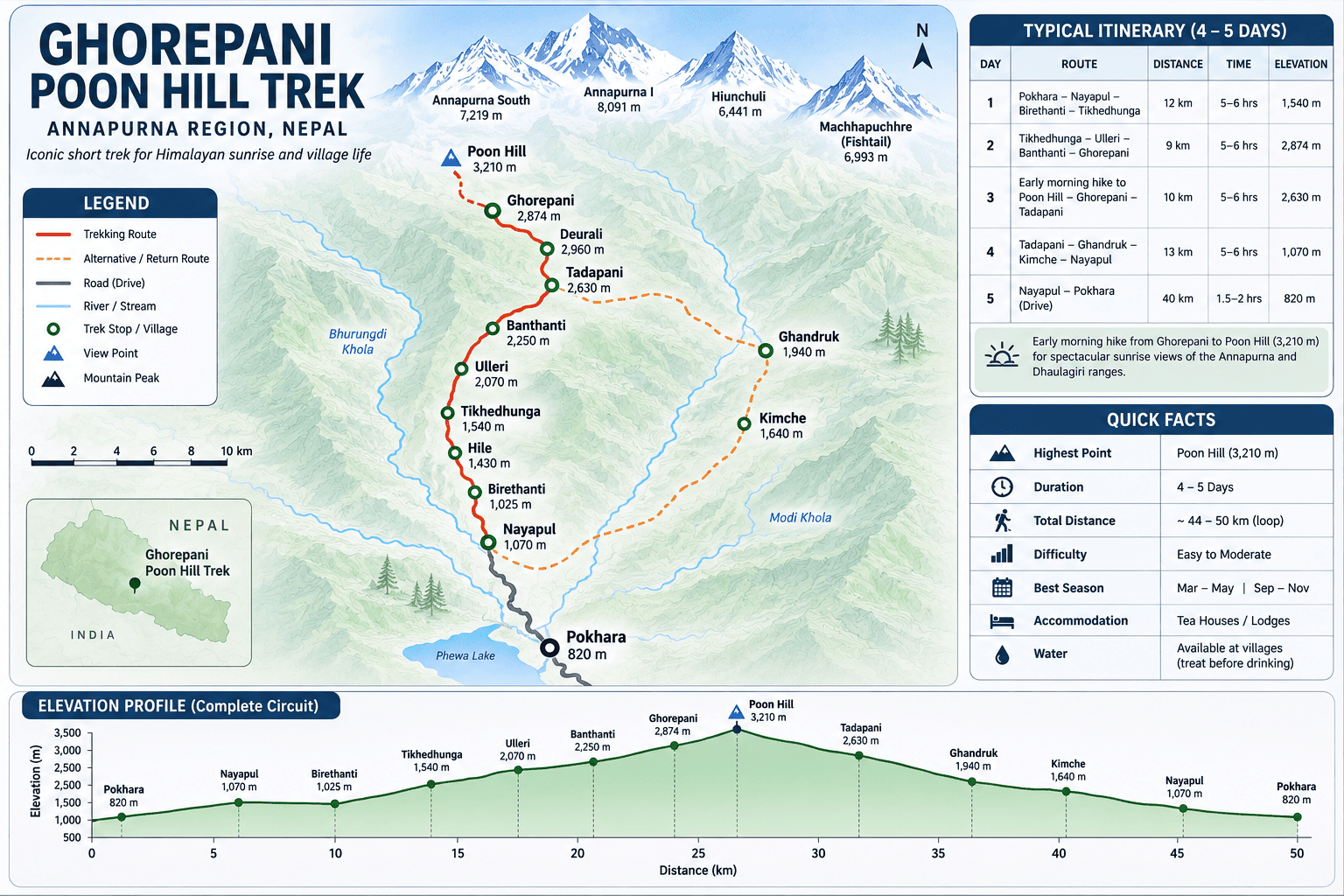
At its core, this is a loop through the foothills of the Annapurna range, starting and ending near Pokhara. The trail climbs through oak and rhododendron forest to the village of Ghorepani, from where trekkers make a pre-dawn ascent of Poon Hill – a viewpoint at 3,210 meters (10,531 feet) that opens onto a jaw-dropping panorama of Annapurna South, Dhaulagiri, Machhapuchhre (the sacred “fishtail” peak), and Hiunchuli, all lit gold as the sun comes up.
Most itineraries then continue on to Tadapani and the traditional village of Ghandruk before looping back to the trailhead, rather than simply retracing the same path — which is part of what makes this feel like a real trek rather than a there-and-back hike to a viewpoint.
It sits within the Annapurna Conservation Area [ACAP — the legally protected zone covering most of the Annapurna region, the largest such conservation area in Nepal], which is also home to the longer Annapurna Base Camp and Annapurna Circuit routes. If you’ve already read our [Annapurna Circuit Trek guide], think of Poon Hill as that trek’s shorter, gentler cousin same mountains, same conservation area, a fraction of the commitment.
“Easy to moderate” is the phrase you’ll see on nearly every operator’s website, and it’s not wrong – but it’s incomplete. The trail never approaches altitudes where acute mountain sickness [AMS — the headache-and-nausea illness that can strike trekkers who climb too fast at height] becomes a serious concern; at 3,210 meters, Poon Hill sits well below the zone where AMS typically starts causing real problems on routes like Everest Base Camp or the Thorong La pass on the Annapurna Circuit.
What the “easy” label glosses over is the terrain. The stone staircase into Ulleri is relentless, and several days involve sustained climbs and descents of well over 500 meters. A reasonable baseline level of fitness – the kind that lets you comfortably climb stairs for an hour – will get you through it. Ultra-marathon training isn’t required, but neither is this a trek to attempt on a whim two days after a long-haul flight.
Two windows dominate: spring (March–April) and autumn (October–November). Spring brings the rhododendron forests into bloom – the hillsides around Ghorepani turn a genuine, almost improbable red, alongside generally stable weather. Autumn offers the clearest mountain visibility of the year, which matters enormously on a trek whose entire purpose is a sunrise view.
Winter (December–February) is trekkable and far quieter, though snow and ice on the higher stretches can slow you down and the pre-dawn Poon Hill climb gets considerably colder. Monsoon season (June–September) brings the least reliable conditions rain, leeches on the lower forested sections, and clouds that can swallow the exact panorama you came for – though some trekkers still make it work with good rain gear and lowered expectations.
There’s a trade-off worth knowing about, though: peak-season clarity comes with peak-season crowds. The viewpoint platform at Poon Hill is small, and in the busiest weeks of October and November it fills to capacity well before sunrise, which means the “sunrise over the Annapurnas” you pictured might come with a few dozen headlamps and phone screens crowded in around you.
For a deeper seasonal breakdown across all of Nepal’s trekking regions, our best time to trek in Nepal guide has a full month-by-month rundown, plus a companion visual you can flip through in seconds.
Two things are certain, no matter when you go. First: you need the Annapurna Conservation Area Permit [ACAP], checked at Birethanti and other points along the route – there’s no version of this trek, guided or otherwise, that skips it. Second: you need a licensed trekking guide arranged through a registered agency. Solo, unguided trekking is no longer the option it once was on this route, full stop.
What’s genuinely still moving is the status of the Trekkers’ Information Management System [TIMS — a trekker-tracking card historically issued alongside ACAP]. Reporting through 2026 has varied on whether it’s been folded into a guide-linked digital system or simply dropped from enforcement in the Annapurna region specifically, and rather than repeat a detail here that might be outdated by the time you read this, we’ve covered the current rules in full in our trekking in Nepal pillar guide, which we keep updated as the regulations settle. Check that before you book.
The classic version of this trek runs five days out of Pokhara, though you’ll find shorter 3-day out-and-back versions and longer variants that fold in extra villages. Here’s the standard loop:
Total distance across the loop runs roughly 30–35 kilometers, with daily walks generally in the 4-to-7-hour range.
Budget for three separate line items: the mandatory fees, the on-trail small stuff, and everything else. ACAP runs approximately NPR 3,000 (roughly $23–30, depending on the exchange rate) – flat, regardless of how many days you spend on the trail. There’s also a small, separate Poon Hill viewpoint entrance fee of around NPR 100, collected right at the gate before the final push to the top – easy to forget when you’re budgeting, and easy to be caught without small local currency at 5 a.m. A licensed guide typically costs somewhere in the $25–50 per day range depending on the agency and season, and most trekkers also budget a porter fee and tip on top of that.
Day-to-day teahouse costs: meals, a bed, hot showers where available – generally land in the $20–40 per person per day range, and it’s worth knowing that prices creep upward the higher you climb, since everything has to be carried in on someone’s back or a mule’s. All told, a fully arranged trip (permits, guide, porter, accommodation, and meals) tends to fall somewhere in the $500–700 range for the classic loop, though prices shift with season, group size, and which agency you book through. Given how much these figures move year to year, treat this as a planning range rather than a quote, and confirm current rates directly with a TAAN-registered [Trekking Agencies’ Association of Nepal — the body that licenses trekking operators] agency before you book.
If you’ve read our Everest Base Camp guide or the Annapurna Circuit Trek post, you already know both of those routes involve upwards of a week or two on the trail, significant altitude exposure, and a real risk of AMS that demands careful acclimatization days. Poon Hill asks for none of that. It’s the trek that fits into a long weekend extension on a Nepal itinerary rather than commanding its own dedicated trip – which is exactly why it’s such a popular add-on for travelers who came to Nepal for Kathmandu and Pokhara and want one genuine mountain day without reorganizing their whole schedule around it.
Because the trail stays below 3,500 meters, you can leave the serious cold-weather mountaineering gear at home, but the temperature swing between a warm Pokhara afternoon and a pre-dawn summit wait at Poon Hill is bigger than people expect, and a lot of first-timers underdress for that specific window. Layering matters more than any single “essential” item. If you want the full breakdown of what experienced Himalayan trekkers pack that beginners consistently forget, we’ve covered that in detail in our hiking essentials guide – it’s written with exactly this kind of shorter Nepal trek in mind. And if you’d rather have offline maps and elevation tracking on your phone than rely on trail signage alone, our best hiking apps roundup covers which ones actually work well in the Annapurna region’s patchy connectivity.
Here’s the honest answer: yes, provided you go in expecting a genuinely physical few days rather than a gentle countryside walk with a nice view at the end. The reward — a 360-degree sunrise over some of the highest peaks on Earth, reached on your own two legs, without the multi-week commitment of the region’s bigger treks – is one of the most efficient “big Himalayan payoff for modest effort” trades Nepal has to offer. Just don’t let anyone tell you it’s easy. Ask my thighs.